
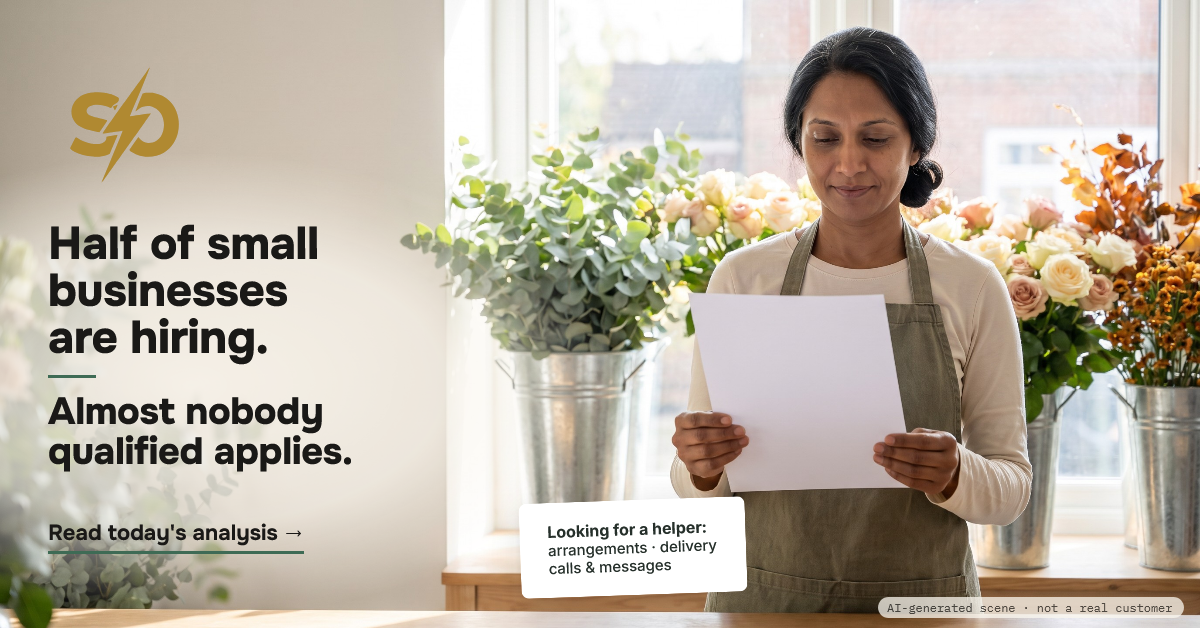
Monday, 7:30 a.m. Anjali opens her flower shop and sets a bucket of eucalyptus by the door. Thanksgiving is a month away, and the December weddings come right after it. On the counter is a note she started on Saturday: "Looking for a helper. Arrangements, local delivery, answering calls and messages." She looks at the last four words and can't decide whether that's one job or two.
Anjali isn't alone. In September, half of America's small businesses were looking for people, and most of them ran into the same problem.
We read this month's hiring reports and looked at what they tell an owner who is about to post a job ad.
Anjali's shop is our sample business.
👥 Many are hiring, and few find the right person
The National Federation of Independent Business (NFIB) surveys small business owners every month. Its September jobs report, as republished by ROI-NJ on October 5, says 51% of owners were hiring or trying to hire. Of those, 87% got few or no qualified applicants. 32% had openings they couldn't fill, 8 points above the historical average. One owner in four (26%) named "labor quality or availability" as their single biggest problem, against a historical average of 12%. And a net 17% still plan to add jobs in the next three months.
The job ad isn't the problem. The problem is that almost nobody who answers it fits.
🎄 The season started early, and some seasonal jobs are turning permanent
On October 15, Indeed Hiring Lab reported that as of September 30, seasonal job postings were up about one-tenth from a year earlier and roughly 7% above 2019. Among a group of large employers, mostly retailers, about 20% of postings are now labeled "seasonal," down from 34% a year ago, while "part-time" rose from 38% to 49%. Job seekers are looking harder too: desktop searches for seasonal work are up 28%.
If even big chains are hiring "part-time until spring," a small shop needs a clear answer: hiring for which job, exactly?
🤖 Where AI is already changing job ads, and where it isn't
On September 17, Hiring Lab sorted millions of U.S. job postings that list a salary by how much AI could change the work. In the most AI-exposed occupations (software development, IT support, data, marketing, finance), the entry-level share of postings fell from 29% in 2021 to one in ten in 2026. In the least-exposed (nursing, caregiving, food service, cleaning, manufacturing), that tilt was about a third as large. The author, Jack Kennedy, concludes that "AI has been acting more as a complement to skilled workers than a replacement." This isn't small business data, and it isn't about front desks, but the direction is clear.
Where the work is answers and paperwork, beginners get hired less and less. Where the work is hands-on, a person is still the answer.
What this means for a shop of five
Anjali's note is two jobs in one ad. Arrangements and delivery take hands, time and taste. Calls and messages are the same ten questions: how much is it, can you deliver today, how late are you open. Hire one person for both, and Anjali will still be on her phone at night, while during the day she waits for her helper to get off a call. Split the note before you post it. Write down the questions that already have an answer. Look for a person where hands can't be replaced.
What to take with you
- List everything the new person would do, and split it into two columns: "hands" and "the same answers."
- For the second column, write down the ten most common questions and a two-line answer to each.
- Decide whether you need someone for the season or "part-time until spring," and say so in the ad.
- Keep only the first column in the ad, and more of the people who apply will fit.
- Ask your ChatGPT what it knows about your business before applicants start looking you up themselves.
In your last job ad, what was "hands" and what was "the same answers"?
