
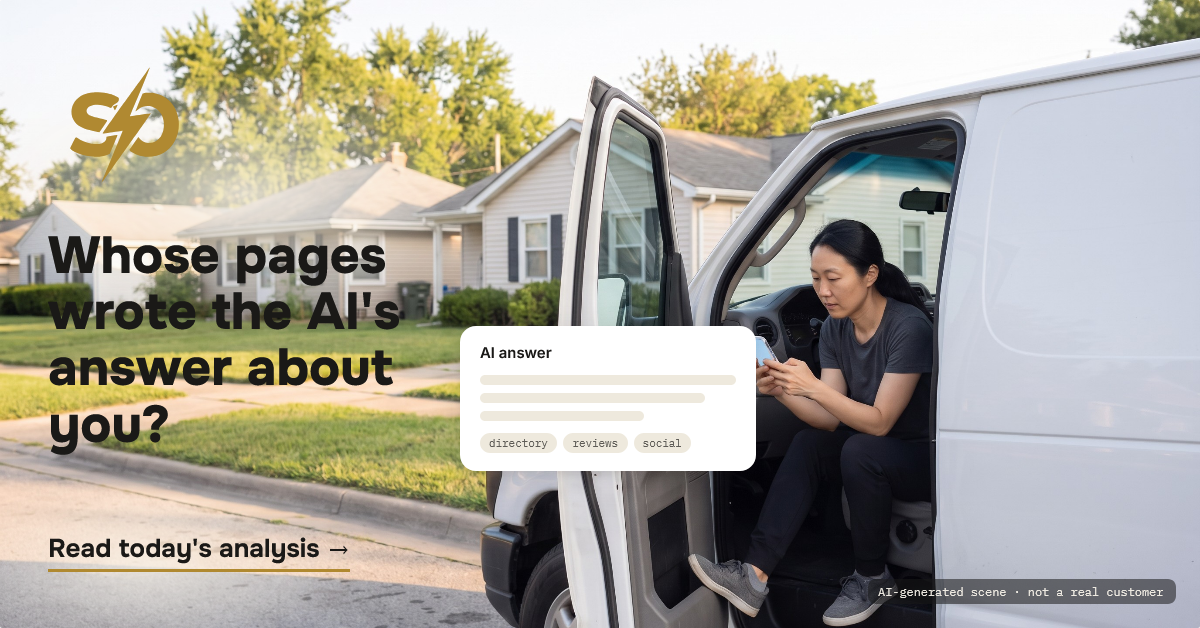
Friday, 7:10 a.m. Hannah is sitting in her van outside the first address of the day. She runs a cleaning company: four people and one van. She has ten minutes before the shift starts, and for the first time she types her company's exact name into a search box.
Above her own link sits an AI answer: who they are, what they do, what people say about them. Under it, in small print, is where the answer came from. A business directory, a review site, a Facebook page she hasn't updated since spring. Her own website isn't on the list.
We read what's known about where these answers come from, and what three companies changed in October in the rules for the pages they're built from.
Hannah's company is our sample business.
📍 Even for the biggest brands, the AI answer now sits above their own link
From July through September, Ahrefs searched U.S. Google every week for the exact names of 100 global brands from the Interbrand list. On July 1, an AI Overview showed up on 5 of 98 usable results. On September 30, it showed up on 63 of 100, and in 48 of those 63 it was at the very top of the page. One caution up front: these are the world's 100 biggest brands, not the shop down your street. And the counts disagree. DemandSphere put the share at up to 90% in late September, and another researcher counted 93 brands out of 100.
The numbers differ, the direction doesn't: more and more often, the first thing people see under your name isn't written by you.
🔗 The answer is built mostly from pages that aren't yours
Ahrefs also looked at which sites those answers linked to. Out of 57 answers with a source list, Wikipedia appeared in 41, YouTube in 22, LinkedIn in 13 and Facebook in 6. A direct competitor's website showed up once in all 57. Some of those pages may be run by the brand itself, like a YouTube channel or a LinkedIn page. The web host Bluehost described how an assistant looks for a local tradesperson: it reads the tradesperson's website and its markup, the Google Business Profile, Yelp, and reviews on other sites. Separately, Bluehost counted AI crawler requests to the sites it hosts. By its own classification, live assistant requests are about 1%, and the rest is training and indexing.
AI doesn't invent you from scratch. It retells what's already written about you, on your pages and on everyone else's.
📜 In October, three companies rewrote the rules for those pages
On October 1, Google added a line to its guidance for websites: generative models "don't retrieve facts, but predict a likely sequence of words," so anything AI wrote should be fact-checked by hand before it's published. That covers page titles, descriptions and markup too. Google's spam policies already call attempts to manipulate AI responses in Search spam. Starting November 12, Anthropic forbids Claude users from "seeding" the sources AI answers draw on with content that hides who wrote it, and it still forbids fake reviews. Meta's new business terms take effect October 30. Under them, Meta may crawl the websites of businesses that use its products, even a business that only has a Page and runs no ads.
The shortcuts are closing from three sides at once. What's left is the direct route: the truth about you, written by you.
What this means for a shop of five
No company promises that an AI will name you, and neither do we. What you do decide is what your own pages say. If your website has no text about what you do, where you work and how to reach you, an assistant will take it from a directory, an old post or a stranger's review. Reviews have to be real. Google's rules forbid offering a discount or a gift for a review, and asking only the customers you know are happy. And anything an AI wrote for you gets read by a person before it goes out.
What to take with you
- Search for your business's exact name and save a dated screenshot. Look at which pages the AI answer links to.
- Split those pages into yours (your website, your Facebook Page, your channel) and other people's (directories, review sites). Start with yours. You can fix those today.
- Put answers to the five questions you get asked most on your website, as plain text. Not as a picture, and not only behind a button.
- Ask every customer for a review, not only the happy ones, and give nothing in exchange.
- If an AI writes your website copy or posts, reread every line before it's published, including the page title and description.
Whose pages are telling assistants about you today, yours or someone else's?
