
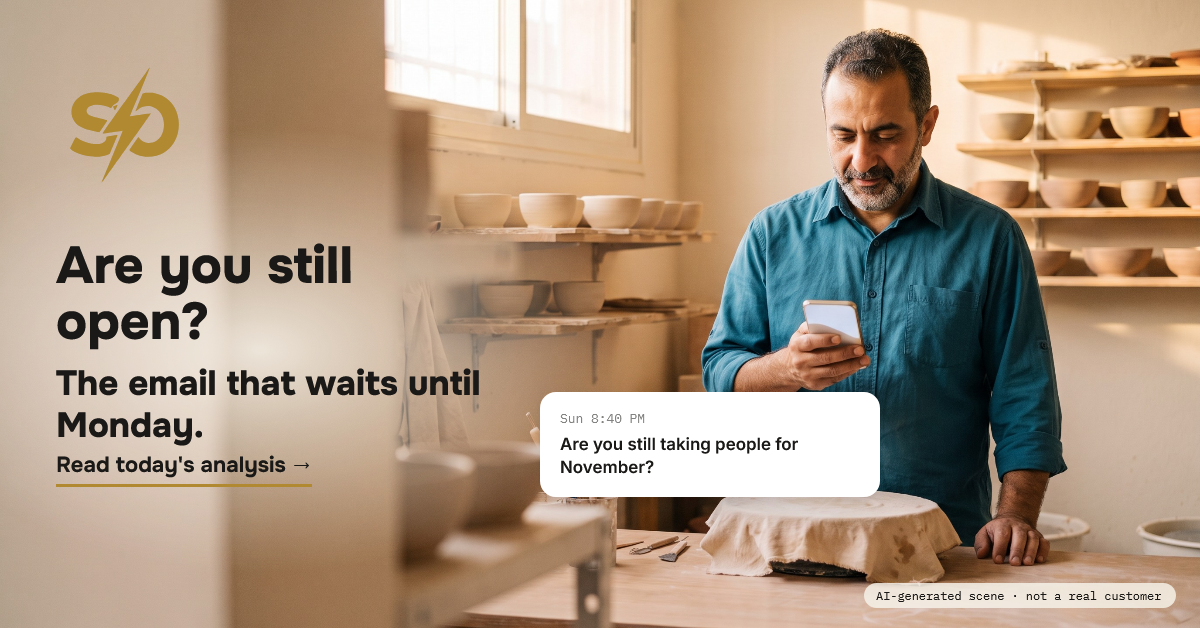
Sunday, 8:40 p.m., Dearborn. Omar Haddad shuts the kiln and wipes his hands. He'd planned to open his email on Monday, but the phone on the table lights up: "Hi! Are you still taking people for the November course? There are two of us. Could we do Saturdays?" There are five more emails under it: a clay invoice, a supplier newsletter, a tax reminder, and two questions from people who want to come in.
Email is the most patient channel. Nobody expects an email answered in a minute. But an "Are you still open?" left until Monday is often no longer a question by Monday. It has become an answer.
We looked at what changed in October in the tools that read email for an owner, and at what Americans themselves say about who they want to hear back from.
Omar's studio is our sample business.
📥 Gmail starts sorting mail into "to do" and "to read"
On October 15, Google announced that Gmail's "AI Inbox" is coming to paid Google Workspace plans. The AI pulls action items, deliverables and deadlines out of your emails into a to-do list, and sums up long threads as "topics to catch up on." For some domains the rollout began on October 12. For most (Scheduled Release) it begins on October 26, which is tomorrow. For now it works only in the U.S., and only in U.S. English.
AI in your inbox is learning to read for you. It can tell you a reply is due. It won't write the reply.
🔁 Automation stops answering the answers
In Workspace Studio, where Google users build automations without code, a new Gmail setting arrived on October 13: a rule can fire only on the first email in a thread and ignore the replies. It's a small change, and a telling one. An auto-reply that answers every "thanks" is a familiar problem, and Google now solves it with a single checkbox.
An automatic answer works for the first email. After that, the conversation belongs to whoever can make the decision.
🙋 Customers want a person, and Americans say so themselves
On October 16, Anthropic, the company that makes Claude, published a survey of 10,980 U.S. adults taken August 11–23. People were asked which obstacles will hold AI back at work the most by 2030, choosing up to three from a list of nine. The one picked most often was "customers preferring to deal with a person." Next came data privacy and security, AI not being reliable enough, and laws, regulations or liability. The same survey found that among people who use AI at work, 26% say a task takes a quarter of the time or less with it.
People don't mind AI at work. They mind getting a reply "from the machine" instead of an answer.
What this means for a shop of five
Email doesn't need an answer in a minute, but it does need a system. Three of Omar's six emails can be closed with a ready answer: hours, open spots, how to sign up. One can only be answered by Omar himself, because it says "there are two of us, could we do Saturdays?" and Saturdays live in his calendar, not in a template. The other two aren't from customers at all. AI can already say "this email is waiting for a reply." Deciding who replies is still up to you. If an assistant replies, it should write as your assistant, not pretend to be you.
What to take with you
- Open your inbox and count the customer emails that have waited more than a day, and write that number down.
- Write down the three questions that reach your inbox most often, with a three-line answer to each.
- Pick one kind of email that only you answer (like "could we do Saturdays?") and keep it away from templates.
- If you use an auto-reply, check that it fires on the first email, not on every "thanks."
- Decide who opens the inbox on Sunday evening, even for ten minutes.
How many customer emails are waiting in your inbox right now?
