
Monday, 8:05 a.m. Luis has been at the counter of his appliance repair shop for five minutes, and the phone has already rung three times. Five people, two vans, and every call goes to whoever is closest. A vendor has offered him "an AI that answers the phone." He keeps picturing a robot quoting a customer the wrong price.
The companies that have already handed their calls to AI started somewhere else. Before the first call, they wrote down what the AI answers by itself and what it hands to a person. We read how three of them drew that line, in reporting from October.
Luis's shop is our sample business.

📍 CarMax: the AI takes the call, people take the sale
CarMax now runs "100% of both inbound store and customer experience center calls" through AI voice agents built with Sierra, CEO Keith Barr said on the company's earnings call on September 29. The agents have been taking those calls since May. They answer questions like store hours and whether a car is in stock, and they pass the rest to associates. Next, CarMax is extending them to booking appraisals, visits and test drives. The sale stays with people: every used car is "an individual SKU," Barr said, and buyers want to see it and drive it first.
The win wasn't a smarter voice. It was knowing in advance which questions end with a person.

📜 L'Oréal: the AI says only what was written in advance
On the YSL Beauty and Kiehl's websites, an AI agent answers order status questions without a human, but only from a library of preapproved language. "The model never writes a new sentence," the Salesforce case study says. Questions that edge toward medical topics go straight to an adviser. After hours, the shopper gets a case number and a follow-up within one business day. L'Oréal aims to handle 60% of order status requests this way. With AI help, advisers now close a case in about 2.5 minutes instead of seven, by Salesforce's count.
Insurance shows the same pattern. Liberate says its agents take the requests that "don't need human judgment," like a certificate of insurance or the status of an open claim, and that one insurer handled 14 times its usual claim volume during back-to-back hurricanes without adding staff. Those are the vendor's numbers. Shoppers draw a line of their own too: PYMNTS Intelligence found that only 24% would let an agent both choose and pay for them.
Money and health stay with people. That isn't a limit of the technology. It's the line itself.

What this means for a shop of five
These are some of the largest companies in the country, and their numbers don't carry over to a repair shop. What carries over is the order of work. They didn't start by picking a voice. They started with a list: what the AI says by itself, what it hands to a person, and what it says at night when nobody is there. A shop of five can write that list in an evening. Without it, the phone is a lottery, with a robot or without one.
What to take with you
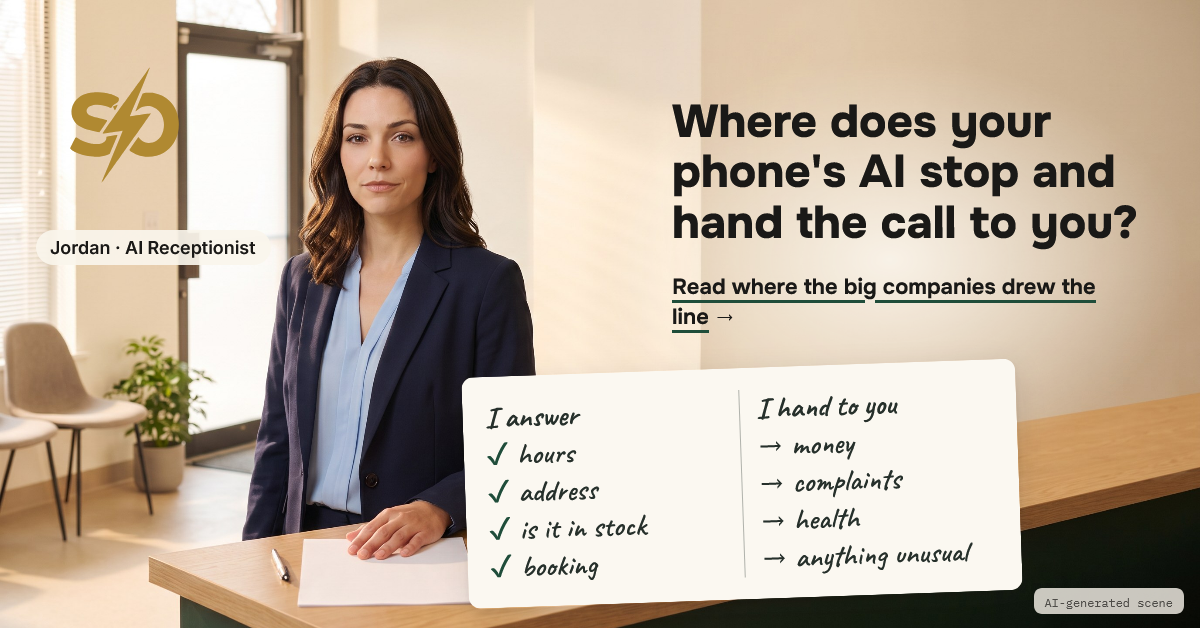
- Write two columns: "the AI answers" (hours, address, what's in stock, booking) and "the AI hands to me" (money, complaints, health, anything unusual).
- Put your real hours in writing, holidays included, so the answer comes from your page and not from a guess.
- Decide how booking works: which slots, how far ahead, and what the AI asks before it books.
- Anything about money goes to a person: refunds, discounts, disputes, an estimate for a job you haven't seen.
- At night, an honest answer: "I've written this down, here's your request number, we'll call you back by 10 a.m."

Where an AI employee fits
At SmashOne, the phone lives inside the AI receptionist role: $49 a month with a line and 250 minutes. She answers from your catalog in English, Spanish and French, takes messages and order requests, and leaves you a written line after every call.
Where does your phone's AI stop and hand the call to you?
