
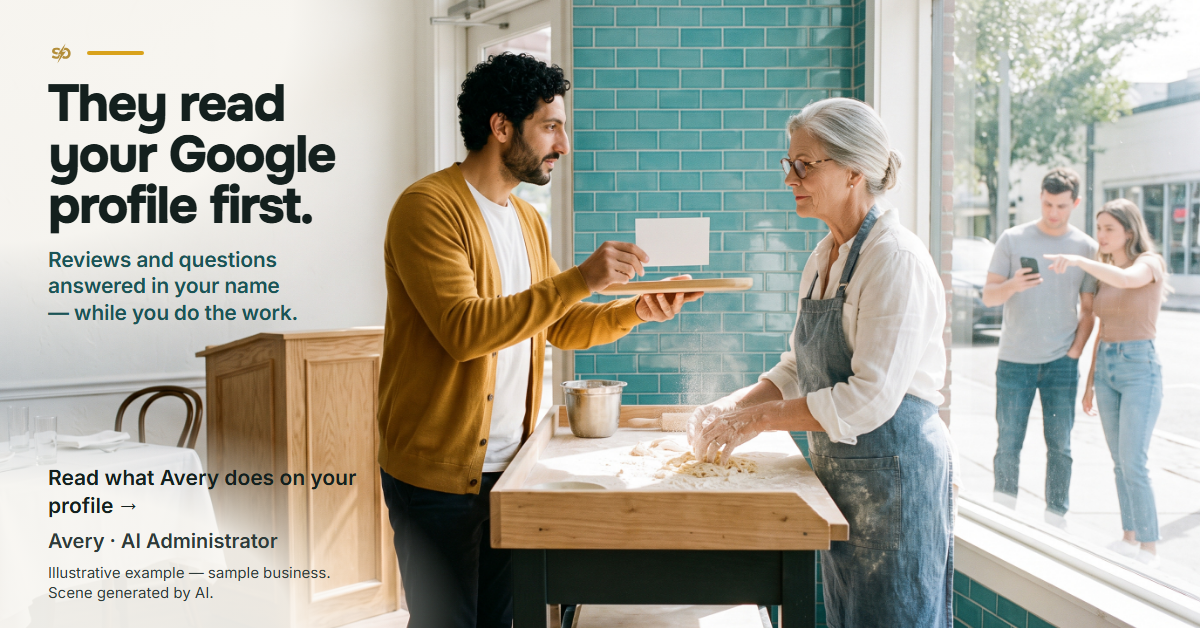
Before anyone calls you, drives over or asks for a quote, they look you up on Google. What they see first is not your website. It is your Google Business Profile — and in a lot of small businesses, nobody is looking after it.
That card is where the decision gets made: call, drive over, book. It costs the owner nothing, and it usually already exists, because Google starts one on its own. That is exactly why it drifts. The hours are last season’s. The services list is empty. The newest photo is years old. A two-star review sits there without a word from the owner, and every stranger who searches “pizza near me” or “lawn mowing Tampa” reads it.
What is actually on the card
The name and the category, the rating and the reviews. Hours, holidays included. The call button, the website, directions — or, for someone who comes to you, the area they serve instead of an address. Photos. Posts: news, offers, events. The list of services. Public questions anyone can ask, and the answers. And under every review, a line marked as the owner’s reply.
For a lawn crew or a nail salon, this card is often the main way new customers arrive — more than the website. It deserves someone on it. It rarely gets anyone, because the owner is busy doing the actual work.
Two owners without a free hand
Margaret Ellison runs Tampa Pasta House. At seven in the evening she is on the pass, and nobody in her kitchen has a hand free to answer a review.
Mateo Salgado is Casa Lista Home Repair: one man, one van, English and Español. He has no storefront — his card shows the part of Tampa he covers — and when a question comes in, he is under a sink.
Neither of them needs one more dashboard. They need somebody on the job.

Who does what on the profile
This is work you hire for. Each AI employee takes the part of the card that belongs to their job:
- Avery, the AI administrator, keeps the facts straight: hours and holiday hours, phone, website, description, service area. For a storefront like Margaret’s, Avery also answers the reviews and the public questions — in the business’s name, from the business’s own data. What isn’t in the data, he doesn’t invent. A complaint or a dispute goes to the owner, not into a public argument.
- Sloane, the AI SMM manager, writes the posts — tonight’s special, a seasonal offer, an event — and adds the photos, the same way she posts to the business’s Facebook, Instagram and Telegram.
- The AI sales consultant keeps the list of services on the card in step with the catalog the rest of the staff answers from.
- At Casa Lista, where there is no counter to stand behind, the public questions and the reviews go to the AI support specialist.

What stays yours
Some things are not for anyone else to touch, and the job is built around that. The business name, the main category and the address are yours; careless changes there are how a profile gets suspended. Verification is yours too — only the owner of the location can start it.
Google also requires that the owner switch on each automatic task explicitly and in advance: replying to reviews, answering questions, editing the card. Connecting the profile does not switch them on. You choose. Anything you have not turned on stays off.
And nobody on this staff will ever offer a customer a discount for a review. Google forbids it, and so do we.

How it gets connected
Google Business Profile is connected on request: you ask, and we connect it to your profile together with you, not through a button.
Everything else is set up by talking. Open the ChatGPT, Claude or Gemini app you already use and tell it about your business — hours, services, rules, who to call when someone is unhappy. There is no screen to learn.
Hire the AI employee first
That is the order we suggest to any business. Work shows up — here, a card nobody has time for. Hire the AI employee first, put it on the job, and see what is left. If something still needs a person, you hire a person for exactly that part, and you know what that part is.

See the work before you hire
Tampa Pasta House and Casa Lista are sample businesses we run ourselves, and both are open to the public at smashone.us/examples. AI employees post and answer there on Facebook, Instagram and Telegram. Write to them. Ask a hard question. Then picture the same care on the one card every customer reads before they call.