
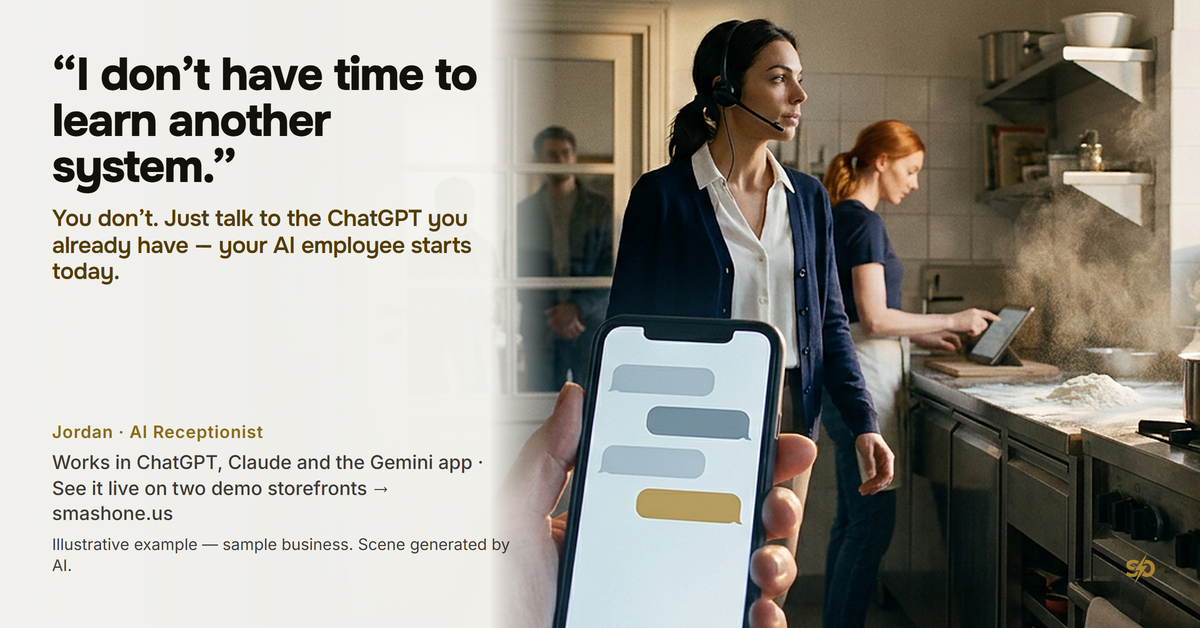
Here is a sentence we hear from almost every owner who looks at us for the first time: “I don’t have time to learn another system.”
They are right, and we agree. So we built it the other way around. You don’t learn our system. It learns to take orders from the one you already use.
One sentence, pasted once
Most owners already talk to an AI assistant every day. It writes the email, drafts the reply to the difficult customer, turns the messy voice note into a clean list. For most of them, that assistant is ChatGPT.
That is where your AI employee gets set up and managed, in three steps. First, hire the employee in your SmashOne account. Then open the ChatGPT you already use. Then copy our setup sentence from smashone.us/easy-setup/ into a new chat and send it: your ChatGPT opens our guide and walks you through connecting, one step at a time. From then on, you set up your employee by saying what you need, in plain words.
There is no screen of ours to learn. There is nobody to schedule an onboarding call with. There is no PDF.
A conversation instead of a form
Setting up an employee is a conversation, because that is how you would do it with a person.
“We’re a home-repair shop in Tampa. We do plumbing, electrical and small carpentry, Monday to Saturday, eight to six. Here’s our price list. Be polite, be short, and never promise a same-day visit without checking the calendar.”
That is the whole onboarding. Your assistant passes it on; your AI employee works from it. Change your hours, add a service, run a promotion, take a product off the list: you say it, once, in plain words, and it is done everywhere your employee works.
You can ask questions the same way. “What did customers write to us yesterday?” “Which posts went out this week?” “Show me tomorrow’s posts before they go.” The answers come back into the same chat, in your language, because the assistant you use already speaks it.
What your AI employee does with that
Say you hired an AI SMM manager. She takes what you told the assistant, your catalog and your own photos, and keeps your pages alive every day: a product, a service, your story, a tip, a promotion. You read tomorrow’s posts today, in the chat or in the calendar.
Say you hired an AI receptionist. She answers your line, in the language of the caller, and books the appointment into your calendar according to the hours you gave. You get the record, not the ringing phone.
Say you hired an AI customer-support employee. She answers where people write, from the same facts, and hands you the one message that actually needs an owner.
The assistant you talk to is the front door. The employees are the ones doing the work behind it. And because everything runs through your own chat, you never have to remember where the settings live.
What it can never do
It never spends your money. Not a dollar, not a subscription, not an ad. Every action your AI employee takes is visible to you, and anything that touches money stops at you. That is not a feature we might turn on later; it is the boundary the whole thing is built around.
And if you decide an employee is not right for you, you say so in the same chat, and she is gone. No cancellation form. No “are you sure” screen.
See it before you believe it
Two real storefronts run this way every day: a pasta house and a home-repair shop, both ours, both set up exactly as described, both fed by AI employees. They are illustrative examples, not customers, and that is the point: you can watch the work before you hire anyone.
The next time you think “I don’t have time to learn another system,” notice that you are probably typing that thought into an AI assistant. That is the system. Hire an employee here, then tell it what to do.
