
On Thursday, Meta released Muse, an AI agent that lives in WhatsApp and, in Meta’s words, negotiates on the user’s behalf — and completes purchases only after the user’s approval, through Stripe’s Link, The Decoder reported. The Verge tried it the same day: the agent found the items, asked about the cart, and bought “once I signed off on the purchase.” By evening, Sensor Tower had counted more than 83,000 U.S. iOS downloads, according to TechCrunch. It is the same week Visa put a number on the other half of the story. In a Visa survey of 2,065 U.S. consumers, reported by Forbes on Wednesday, 23 percent trust an AI agent to spend their money; attach Visa’s name to the transaction and the figure nearly triples, to 61 percent. Almost three quarters of the same people have already used an agent for something. They let it read, compare, plan and recommend. They do not let it pay — which is exactly the step Meta left to the human.
Visa’s own chief executive had said the same thing on Tuesday, a day before the Forbes piece, on stage. “We are seeing adoption for shopping, but not yet for autonomous payments,” Ryan McInerney told the Goldman Sachs conference on Tuesday, according to PYMNTS. People use the models to compare and choose, he said, and then go to the seller’s own site to finish. Asked to name the barrier in one word, he chose “trust.”
Read those two sentences together and you have the state of the market in September 2026. The choosing has moved. The paying has not.
The choosing has moved
It moved quietly, and it moved a lot. We wrote yesterday about the Profound data: since July, most of ChatGPT’s shopping recommendations in its tracked runs come from merchants’ product feeds, and the model references fewer merchants to make them. This week the same shift showed up one level down, in the grocery aisle. On Wednesday, Instacart introduced Cart Assistant, a white-label AI shopper that regional grocers can put on their own sites, built on 1.6 billion orders and real-time inventory from about 100,000 stores. Food Bazaar, Woodman’s and Heritage Grocers are already live; Heritage built the Spanish-language version. “Order my usuals,” a customer says, and a cart appears.
And on Tuesday, Inc. reported the other side of the same coin: a Resy user had his account deactivated and every future reservation canceled after his personal AI agent hit the reservation site 200 times an hour. Resy, Amex and Uber, the piece says, are all cracking down on agents that behave like bots. The platforms want the customer, not the customer’s robot. Forbes lists four separate protocols now being built to answer one question: how does a merchant know the agent at the door is a real customer’s real agent?
So the customer arrives with the choice already made by a machine, and the machine may or may not be welcome. Either way, what happens next happens with a person.
The paying has not
This is the part that matters if you run a shop, a clinic, a restaurant or a repair business rather than a payments network. The last step, the one where money moves, is still human, and it is going to stay human for a while. Visa’s Oliver Jenkyn, in the Forbes interview, expects the first fully autonomous purchases to be boring ones, corporate procurement, where every rule is written down. Everything else, he says, will be “human-in-the-loop” for the foreseeable future.
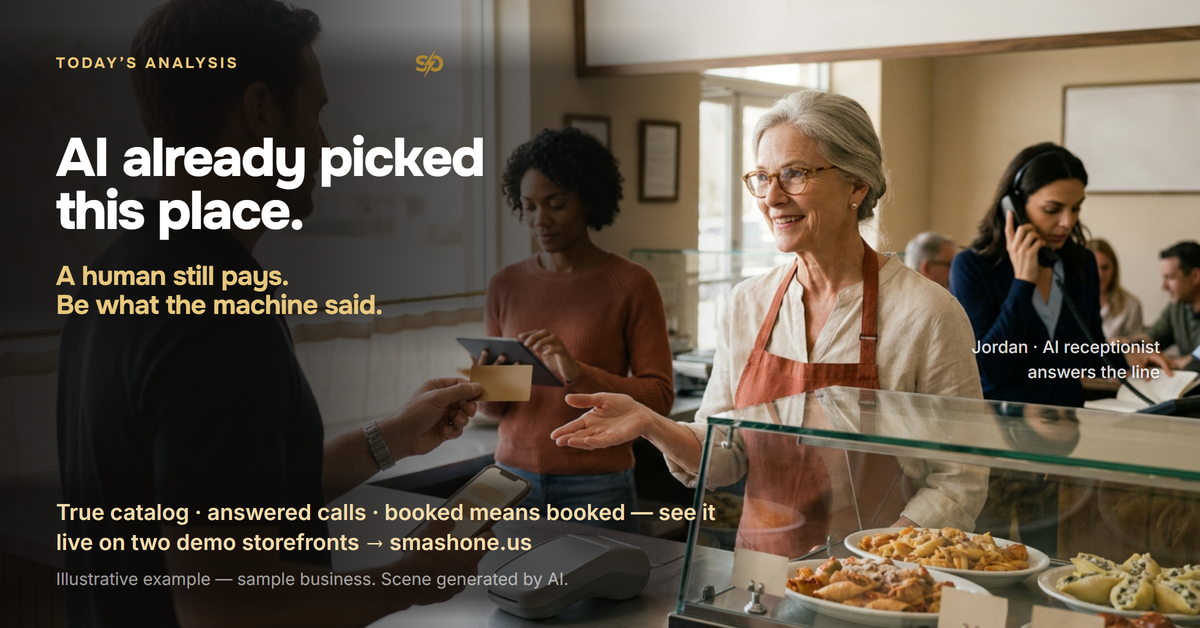
For a small business that is not a delay. It is a gift. It means the decisive moment of the sale is still yours: the moment between “the AI says this place” and “I’ll pay.” What decides that moment is not clever. It is whether what the machine told the customer turns out to be true when they arrive, and whether someone answers when they ask.
What the customer checks in that moment
Three things, in the order they happen.
Is the information true? The AI told them you are open until six and that the repair starts at a certain price. If your site says one thing and your listing another, the agent has already picked one of them, and if it picked wrong, the customer blames you, not the agent. One current version of your catalog, hours and prices, everywhere, is no longer housekeeping. It is what the machine reads out loud.
Does someone answer? The customer who was handed to you by a recommendation is warm for about as long as a page takes to load. A message that sits until tomorrow, a phone that rings out at lunch, a “we’ll get back to you” form: each one sends them back to the machine, which will happily name someone else.
Can they finish? Book the slot, place the order, get a confirmation that a human will honor. Not “the agent thinks it’s booked.” Booked.
What the industry is telling small businesses to do about it
Google spent August driving Route 66 with hands-on AI workshops for small business owners in five states, and cites U.S. Chamber of Commerce figures that 85 percent of small businesses using AI saw sales rise in the past year. OpenAI, the same week, pointed small businesses at a catalog of plugins built for them. Instacart is selling regional grocers their own assistant. The message from every large platform is the same: the customer will arrive through an AI, get ready.
“Get ready” is vague. The three checks above are not.
How we think about it
This is exactly the seam an AI employee at SmashOne is built to sit in. It answers from the owner’s own catalog, hours and prices, so what the customer was told and what they find are the same thing. It answers where people write and on the line, at lunch and at night, so the warm customer is not sent back to the machine. It holds the slot or the order and brings it to the owner for confirmation, so “booked” means booked. And it never takes money on the owner’s behalf: the paying stays with the human, on both sides, which is precisely where this week’s numbers say it belongs. You set it up by talking, in the ChatGPT app you already use, and you can watch the whole loop run on two demo storefronts before you hire anyone. Works with ChatGPT today; Claude and the Gemini app are next.
AI has taken over the choosing. It has not taken over the paying. Between the two there is a person with their wallet out, waiting to see if you are what the machine said. Be that.
Sources
- The Decoder — “Muse can shop, write emails, and negotiate prices for users, all through WhatsApp”
- The Verge — “Meta’s Muse AI works and creeps me out”
- TechCrunch — “Meta’s AI agent Muse is now the No. 2 app in the US”
- Forbes — “23% Of Us Trust AI Agents To Spend Our Money. Visa Has A Plan”
- PYMNTS — “Visa CEO Says AI Shopping Has Arrived but Agentic Payments Haven’t”
- Digiday / Modern Retail — “Instacart’s custom AI assistants for retailers”
- Inc. — “Resy Deactivated a User After His Automated Assistant Made 200 Requests an Hour”
- Google — The Keyword — “Helping small businesses win with AI”
- Search Engine Journal — “ChatGPT Shopping Results Lean Hard On Product Feeds”
- PYMNTS — “Merchants Put AI to Work Without Handing Over the Customer”
- Search Engine Journal — “Getting Your Product Into ChatGPT Isn’t The Hard Part, Getting It Through Checkout Is”
