
How to hire an AI employee
Choose the job you need covered, read its scope and limits, and check the current terms before hiring. For phone calls, start with the AI receptionist’s duties and boundaries: Jordan answers from your business data and brings booking requests to you for confirmation. Read the comparison with a phone answering service and the current terms and availability.
Every owner knows the moment. It usually arrives late in the day, somewhere between the delivery that came up short and the customer who has messaged three times since this morning. You look at the day and understand that there is more work than there is you.
And so you start thinking about hiring.
Then you do the math, and the thought dies right there. A person costs thousands a month, and that's before you've found them. First you write the posting. Then you read forty replies and answer twelve. Then you interview, and one of them is good but wants more than you can pay, and another is affordable but you're not sure. Then you hire, and for six weeks you're not getting help — you're giving it, explaining what you sell and how you speak to people and what to do when someone asks for a discount. Then, sometimes, they leave, and the six weeks leave with them.
So you don't hire. You stay late instead. And the messages that arrive at nine in the evening sit there until morning, because you're a person and you were asleep.

We built SmashOne for the step before that one.

What we actually do
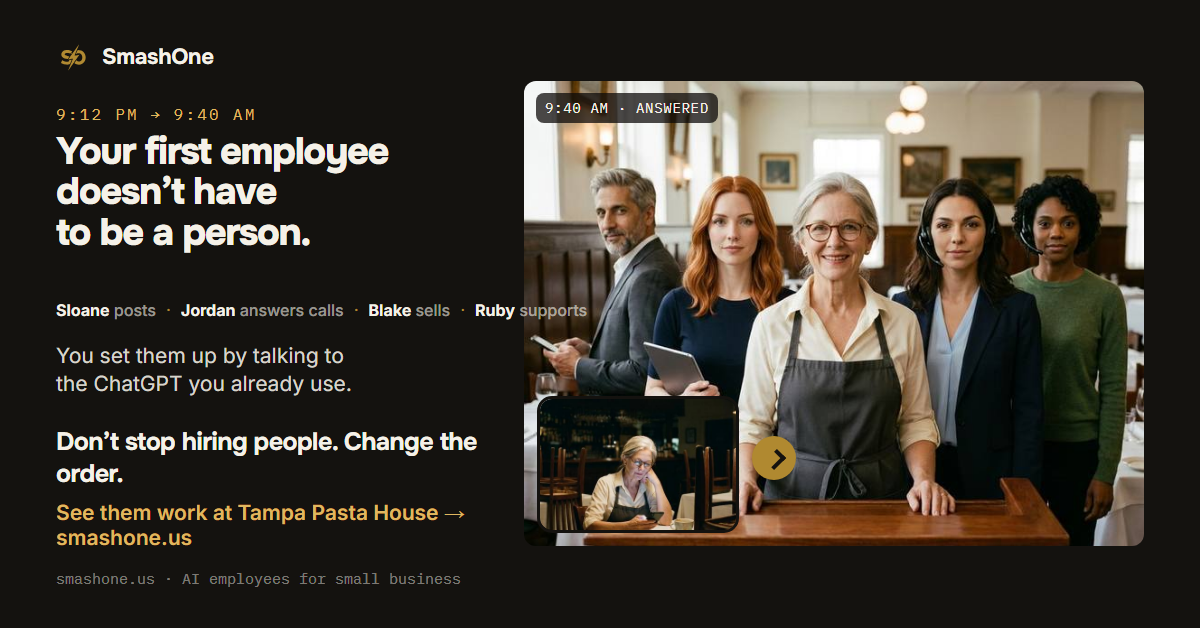
We are the place where a small business hires an AI employee. Not software you learn. Not a dashboard you check. An employee — one who has a job and does it every day, and costs a fraction of what a person does.
The difference is bigger than it sounds. A tool waits for you to open it. An employee works while you are doing something else. That is the whole distinction, and everything about how we built this follows from it.
You hire an AI SMM manager, and your pages get posts on the days you would have skipped. You hire an AI receptionist, and the phone gets answered at eleven at night, in the language the caller speaks. You hire an AI sales consultant, and the person asking what size you have in stock gets an answer while they still care — not tomorrow, when they have already bought it somewhere else.

None of them needs training. They arrive knowing the shape of the job. What they need from you is what any new hire needs: to know your business. Your catalog, your hours, your prices, how you like to sound.
And here is the part people don't expect
You tell them all of that in a conversation. Not in our workspace — in the AI you already have open. ChatGPT, Claude, the Gemini app, whatever you use. You paste one address into it, once, and from then on you can say "add the fall menu," "answer in Spanish too," "stop posting on Sundays," and it happens.

Most owners we talk to will never open our workspace. That's not a gap in the product. That is the product. We built the workspace for the people who want to see everything, and we built the conversation for everyone else — which, by our count, is almost everyone.
What you get, precisely
One AI employee, for a month. One channel of your choosing comes with it — your Facebook page, your Instagram, your Telegram, or your WhatsApp — wherever your customers actually are; more channels can be added. Each AI employee comes with its own monthly allowance of AI replies, and when it runs out, it stops rather than quietly charging you more.
You get a free week before anything is charged. If you've paid and it turns out this isn't for you, you have fourteen days from that charge to say so and get your money back.
We're telling you the terms plainly because the alternative is that you find them later and feel misled. Setup costs nothing. There is no annual contract, and no salesperson will call you. The exact price is on the site, and any of our assistants will tell you if you ask.
Before you pay, you can watch one work
Two demo businesses we run ourselves — a pasta house and a home-repair shop, illustrative examples rather than customers — run on this every day. Posts go up. Their customers' questions get answered. You can go look at a week of it before you decide anything, which is a strange thing for a company to offer and, we think, the only honest one.

The order we are arguing for
We're not saying don't hire people. We're saying change the order.
When the work outgrows you, hire the AI employee first. Give it the part of the job that is a pattern — the answering, the posting, the following up, the not-forgetting. See what is left after that. Sometimes what's left is small enough that you don't need anyone. Sometimes it's exactly the job you should have been hiring for all along, and now you can describe it properly — and pay properly for it — because an AI employee costs a fraction of what a person does.
Your first employee doesn't have to be a person. It just has to show up.
