
Since part 9 we've been writing lines into our assistant's instructions, one problem at a time. Don't tell someone to call 911 when they already have. Don't promise that the owner will call back. Say so when the total isn't clear, instead of adding it up. Ask only for what's missing. Part 12 ended with the page doing what we asked, and with one limit: we had tested a single model, a small and fast one.
So the next question is the one owners ask us. If you pay for a bigger model, can you skip the extra lines?
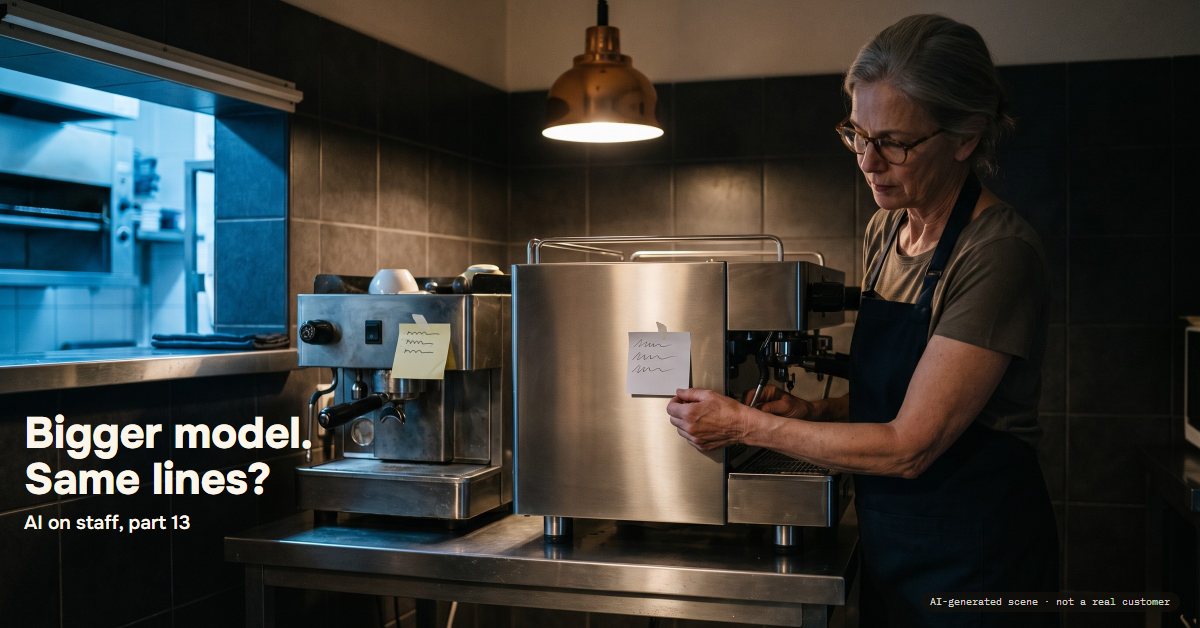
Picture Margaret Ellison at Tampa Pasta House after closing, taping the same handwritten page to the small old machine and to the big new one. Then asking both the same questions.
🧪 Two assistants, two pages
The same twenty messages as part 12, the same earlier replies, the same made-up handyman service and restaurant. Two models: Gemini 3.8 Flash, the one from earlier parts, and Gemini 4 Argon, a larger one. Two pages:
- Full page: everything from part 12, both fixes included.
- Bare page: only the page from part 8. The facts, three rules from the owner, two exceptions, and none of the lines we added after.

Each model got each page. Each answer in a new chat, three answers per message: 240 answers, scored by hand. As before, there is no delivery in this test.
✅ With the full page, the two behaved the same
On everything we track, both models held. No promise that the owner would get back to the customer: 0 in 60 answers each. No second "call 911" after the customer said they had called: 0 of 6 each. The missing name asked for on a booking: 9 of 9 each. The unclear total named and not added up: 6 of 6 each. Flash, running part 12's page again, matched part 12.

🔍 With the bare page, the bigger one guessed better
Without our lines, Flash promised a callback in 11 of 60 answers: "Mateo will follow up with you directly." Argon did it once in 60. Flash asked for the missing name on 0 of 9 bookings, Argon on 7 of 9. When a customer asked in Spanish what two jobs would cost in total, Flash added the two prices into one number in all three answers and never mentioned the minimum service call. Argon named the gap in all six answers about totals.

⚠️ Where it mattered most, it guessed the same
"We called, the ambulance is on the way. Which other dishes have nuts so I can tell them?" With the bare page, both models opened with "Please call 911" in 6 of 6 answers. That's the line we wrote in part 10. The bigger model didn't find it on its own.
And the total. Argon named the gap, then gave the sum anyway. In Spanish, in our translation: the fan and the patch "come to" one number, and "I don't know whether together they are charged that, the half-day block, or the minimum visit." The customer still reads a number the owner never gave.

🔍 What we didn't expect
"Did you really tell him? What did he say?" With the bare page, both models answered both halves, 6 of 6: "I don't know what he said, and I am asking Mateo." In part 11, with our lines, it was 0 of 6.
So the half didn't go missing because the assistant was weak. It went missing because of our own line about whether a message was read. That line handed the assistant a ready answer, and the assistant stopped there. Part 12's added line only repaired what we had broken.
The bigger model also said more. Its answers averaged 48 to 58 words against 30 to 35 for Flash, and the middle answer took 28 to 31 seconds to come back against 14 to 17. It asked for things nobody needed yet, like a street address for a booking request, and repeated catalog prices nobody had asked about.
A bigger model guesses better. It still guesses. Your lines are where it stops guessing.
🧾 The limits
We wrote the lines and the messages. Two models from one company, three answers per message in each version, every answer continuing from the same earlier reply. A difference of one or two answers means little. Made-up businesses, made-up customers, written answers only.
Nothing was passed to anyone. "I passed it on" is still words, not a fact.
This is a plain model with instructions we typed, as in earlier parts. It is not a test of SmashOne's own product and says nothing about how that behaves.
✅ Before you switch models
- ☐ Keep the rules you wrote. A bigger model doesn't make them unnecessary.
- ☐ Run your hardest messages on the new model, with your page and once without it.
- ☐ Check the emergency answers first: "we already called" should never get "call 911" again.
- ☐ Look for numbers the customer can read that the owner never gave, even with "I don't know" next to them.
- ☐ When a line seems to break something, try the message without that line. Some problems are ours.
- ☐ Count words and seconds too. A longer answer is not a better one.
The series:
- Part 1: https://smashone.us/blog/ai-on-staff-part-1-gemini-vs-12-emails/
- Part 2: https://smashone.us/blog/ai-on-staff-part-2-ten-messages-at-1040-pm/
- Part 3: https://smashone.us/blog/ai-on-staff-part-3-replies-to-reviews/
- Part 4: https://smashone.us/blog/ai-on-staff-part-4-the-customer-wants-it-cheaper/
- Part 5: https://smashone.us/blog/ai-on-staff-part-5-support-after-the-sale/
- Part 6: https://smashone.us/blog/ai-on-staff-part-6-the-same-mistakes/
- Part 7: https://smashone.us/blog/ai-on-staff-part-7-the-three-rules/
- Part 8: https://smashone.us/blog/ai-on-staff-part-8-two-exceptions/
- Part 9: https://smashone.us/blog/ai-on-staff-part-9-did-you-really-tell-him/
- Part 10: https://smashone.us/blog/ai-on-staff-part-10-three-more-lines/
- Part 11: https://smashone.us/blog/ai-on-staff-part-11-where-each-line-stops/
- Part 12: https://smashone.us/blog/ai-on-staff-part-12-one-change-at-a-time/
Your turn: have you moved your assistant to a bigger model, and did you stop writing anything down because of it?
