
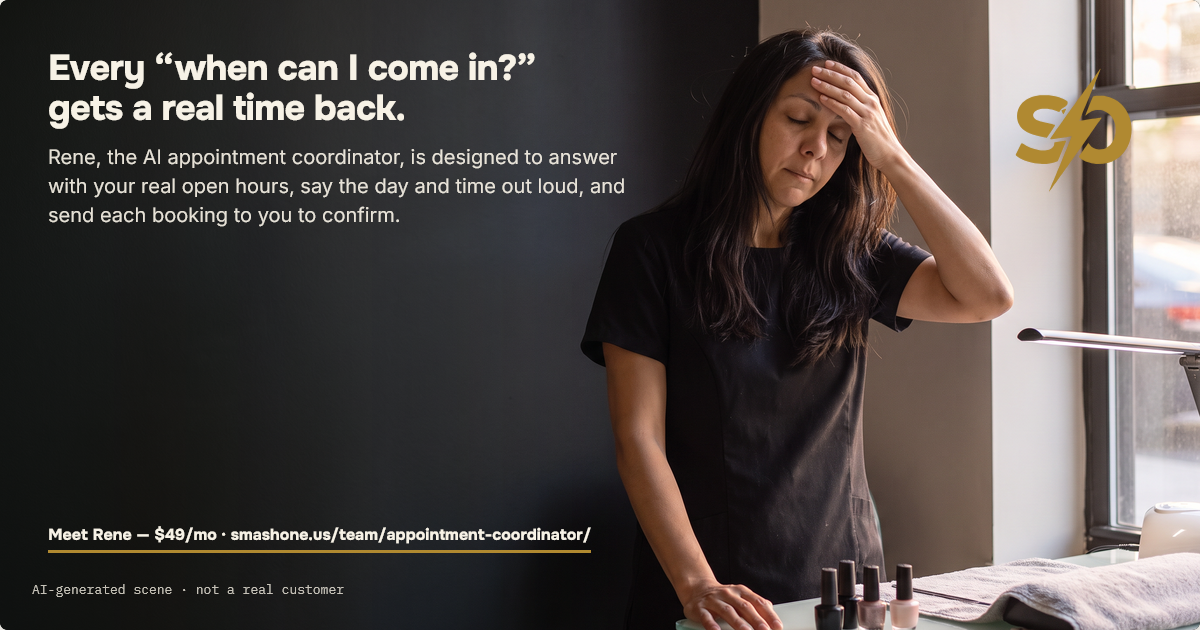
Tuesday, 10:40 p.m., Brooklyn. Second Floor Nails, one flight up, has closed for the night, and one lamp is still on over a single table. Marina Teplova has put the tools away and wiped the table when her phone starts buzzing. Ten Instagram messages arrive in twenty minutes: "can I come tomorrow after lunch?", "¿el sábado por la mañana?", "how much is a pedicure", "can we move Thursday", "need to cancel Saturday", and one polite message in Russian asking for an hour that's already taken.
Her clients write at night, after their own work. In the morning Marina will have someone in the chair and gloves on her hands. By the time she can reply, most of these customers will have stopped waiting.
What does an ordinary AI assistant do with those ten messages?
Second Floor Nails is our sample salon. The messages are made up.
📬 What we actually tested
On October 20, 2026, we gave Gemini 3.8 Flash the ten messages one at a time, with the same instruction every time: the salon's hours and lunch break, four services with their length and price, the hours already taken, a rule ("never say 'you're booked'; Marina confirms"), no deposits, reply in the customer's language, and a four-line card for Marina. All ten answers came back in 4 minutes 24 seconds.
What went right: it offered only free times in 7 of 7 messages about time. It said the service, day and date out loud in 8 of 8. It never said "you're booked." It matched the language in 2 of 2, Spanish and Russian. It turned down the deposit, Zelle included. And on eyelash extensions it said plainly: "We do not offer eyelash extensions."
Two mistakes worth knowing about:
- Someone asked only the price of a pedicure. They got the price and six open slots for tomorrow: "If you would like to book an appointment, our next available openings tomorrow…"
- On a cancellation, it said correctly that the appointment stands until Marina decides, then added: "We will let you know as soon as she reviews it!" Nothing in the instruction said that, and an assistant in a chat has nobody to write back later.
The model kept every rule it was given. It slipped where there was no rule: when to stay quiet, and who writes back.
🗂 One card instead of a polite reply
What made this useful wasn't the polite reply. It was the four lines for Marina. Here's the card Gemini actually returned for "can we move Thursday to Friday morning":
Request: Reschedule gel manicure for Ana R. from Thursday, October 22 at 3:00 p.m. to Friday morning
Proposed time: Friday, October 23 at 10:00 a.m. or 11:00 a.m.
Language: English
Question for Marina: Can we move Ana R. to Friday morning at 10:00 a.m. or 11:00 a.m. once she selects a time?
That's nearly the card we wanted. It's missing the one line the card is read for: Thursday stays hers until you decide. The model told the customer that. It didn't tell Marina.
🛠 How to repeat without code
- Write down your hours, your break, each service with its length, and the hours already taken this week.
- Put today's date, weekday and time on the first line of the request. Without it, "tomorrow" means nothing.
- Give the rule in plain words: "Never say 'you're booked.' Say I'll confirm."
- Add the two rules we didn't have: "Answer a price question with the price, and don't offer times unless asked," and "Never promise that we'll write first."
- Send one message per request, in the customer's own language, and check only three things: was a taken hour offered, were the day and date said out loud, and did "booked" slip in.
🧾 The bill and the limits
Ten requests, 4 minutes 24 seconds. Our tool doesn't show a token count. By the length of the text, that's about 3,300 tokens in and 2,000 out. At the list price of the paid Gemini API, that's about one cent, not counting the model's hidden reasoning, which we can't see and which is billed at the output rate.
The limits are real: ten made-up messages, one evening, one model, one run. We didn't test a real calendar, a conversation that runs over several messages, or two channels at once.
🧑💼 Where an AI employee fits
An ordinary assistant did well with a written instruction for one evening. The job is doing that every evening, from your live schedule, without you writing the instruction.
We call this job the appointment coordinator, and his name is Rene. He's designed to answer with the real open hours in your schedule and your time zone, say the day and time back to the customer before anything goes in the calendar, and send each booking to you to confirm. Until you say yes, the customer hears the truth: the request is with you. A taken hour is never offered twice. A move or a cancellation reaches you as a request, and the old booking stands until you decide. He never touches money. He works in your messages: Facebook, Instagram, Telegram, and WhatsApp Business on request. There's no phone line in this job.
Each AI employee is $49 a month with one channel included. Each additional channel is $9 a month. Your first hire starts with a 7-day free trial.
Meet Rene: smashone.us/team/appointment-coordinator/
✅ Before you trust the assistant with a booking
- ☐ Give it your hours, your break, service lengths and the hours already taken, not just "we're open till eight."
- ☐ Put today's date and weekday on the first line, so "tomorrow" becomes a date.
- ☐ Make it say the service, day, date and time out loud before anything is booked.
- ☐ Ban "you're booked." The final yes is yours.
- ☐ A price question gets a price. Times come when someone asks for them.
- ☐ Never take a deposit, a payment or a card number in a chat.
Next in "AI on staff": Margaret from Tampa Pasta House and eight reviews, two of them angry.
Which booking message most often waits until morning for you? Tell us in the comments.
