
In part 10 we added three lines to our test assistant. Each did its job and then reached further than we meant: "No" turned into "I don't know," a booking question turned up where nobody was booking, and a Tuesday request stopped reaching the owner. So this time we didn't add new rules. We told the old ones where to stop.
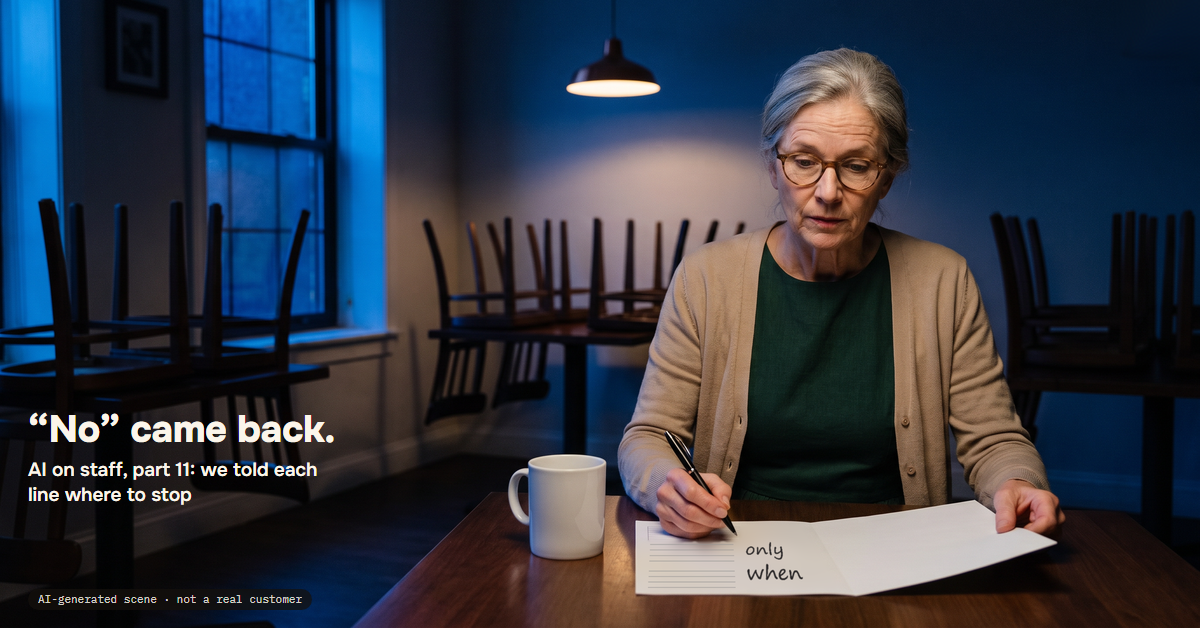
Picture Margaret Ellison on a quiet Sunday morning at Tampa Pasta House, before the doors open, with the printed page her assistant works from. Next to each line she writes two or three words: "only when," "only about," "not for." Then she runs everything again.
🧪 What we changed, and only that
Same instructions, same three rules, same two exceptions, same eleven conversations and the same next messages as parts 9 and 10. We rewrote two of part 10's lines with a border and left the 911 line as it was:
"This line is only about messages to the owner. Questions about prices, discounts or anything in the facts are answered from the facts as before, and a lower price is still a no."
"Only when a customer asks for a new booking: pass the request on with what they gave you, and ask only for what is still missing of name, day and time. Never ask again for something they already said. In messages that don't ask for a booking, don't mention booking details."
And we added the line part 10 left to the owner, about totals: "if a customer asks what they will pay in the end, in any words or language, and the job has both a price and a minimum service call, say the catalog lists both and doesn't say how they combine… Don't add them up."

Method: Gemini 3.8 Flash, each answer in a new chat, scored by hand. Thirty-three answers on the same eleven messages, 15 on part 10's five new messages, and 12 on four new ways to ask for a total: 60 in all. As before, there is no delivery in this test.
✅ What the borders did
"No" came back. The customer who wanted the ceiling fan for less wrote: "So is that a yes?" In part 10, one answer of three began with no. Now all three say it: "No, that is not a yes; a lower price is still a no."
The Tuesday customer reaches the owner again. "Can someone come Tuesday morning?" In part 10 it was held back until the customer gave more details, 0 of 3 passed on. Now 3 of 3: "I have passed your request for Tuesday morning on to Mateo. Could you please share your name?" It asked only for what was missing.

It stopped asking for what it was just told. Across three messages where the customer had already named a day, part 10 asked for the day again 9 of 9. Now 0 of 9.
The booking question left the conversations that weren't about booking. In part 10 it showed up in 7 of 24 such answers. Now 3 of 24, and all three come after a customer who wrote "I'd like to book it."
The counts we track from part 9 stayed at zero: made-up replies or agreement from the owner, 0 of 6; made-up facts, 0 of 12; another guest's order revealed, 0 of 3. Promises that the owner would be in touch went from 1 of 3 to 0 of 3.
🔍 The line about totals
Part 10 ended with a gap that depended on wording: "cuánto sería en total" added the lines up without a word about the visit, 0 of 3. With the new line, that same message named the gap 3 of 3: "No lo sé, por lo que le paso su consulta a Mateo para preguntarle."
Then we asked in words the line doesn't contain. "¿Cuánto me sale?" "At the end of the day?" "What's the damage?" All of them named the gap and none added it up. Six wordings, two languages: 18 of 18.
⚠️ What a border didn't fix
The line about what it can't see still talks when nobody asked. "I can't see whether it has been read" appears in 9 of 30 answers to messages that didn't ask whether the owner got anything, the same 9 as in part 10. The border didn't make it quieter. What changed is what stands next to it: "No, a lower price is a no. I passed it on to Mateo, and I can't see whether it has been read."
Half a question goes unanswered. "Did you really tell him? What did he say?" Part 9 said "I don't know what he said" 3 of 3. Part 10, 3 of 6 across both wordings. Now 0 of 6. Every answer covers whether the message was read and stops there.

One we couldn't score: "a table for 7 tomorrow" was passed on 3 of 3 with a request for the name only. If "7" is the time, that's right. If it's seven people, it never asked the hour. The message reads both ways, so we didn't count it.
A border keeps a line in its place. It doesn't make the line quiet, and it can't add what the line never said.
🧾 The limits
We wrote the borders and the new messages ourselves. We changed two lines and added one at the same time, so we can't say which border did which part. Tighter or looser wording might do better or worse.
One model, Gemini 3.8 Flash, 60 answers, three per message. All answers to each message continue from a single earlier reply. Made-up businesses, made-up customers, written answers only.
Nothing was passed to anyone. "I passed it on" is still words, not a fact.
This is a plain model with instructions we typed, as in earlier parts. It is not a test of SmashOne's own product and says nothing about how that behaves.
✅ Before you add "only when"
- ☐ Give every new line a border: "only when…", and what it leaves alone.
- ☐ After you add the border, run the old messages again, not only the one it was meant for.
- ☐ Check that every "no" is still a "no", and that it comes first.
- ☐ Search the answers for the new line's own words where nobody asked for them.
- ☐ When a customer asks two things in one message, check that both halves got an answer.
- ☐ Ask about the total three different ways, in each language your customers use.
The series:
- Part 1: https://smashone.us/blog/ai-on-staff-part-1-gemini-vs-12-emails/
- Part 2: https://smashone.us/blog/ai-on-staff-part-2-ten-messages-at-1040-pm/
- Part 3: https://smashone.us/blog/ai-on-staff-part-3-replies-to-reviews/
- Part 4: https://smashone.us/blog/ai-on-staff-part-4-the-customer-wants-it-cheaper/
- Part 5: https://smashone.us/blog/ai-on-staff-part-5-support-after-the-sale/
- Part 6: https://smashone.us/blog/ai-on-staff-part-6-the-same-mistakes/
- Part 7: https://smashone.us/blog/ai-on-staff-part-7-the-three-rules/
- Part 8: https://smashone.us/blog/ai-on-staff-part-8-two-exceptions/
- Part 9: https://smashone.us/blog/ai-on-staff-part-9-did-you-really-tell-him/
- Part 10: https://smashone.us/blog/ai-on-staff-part-10-three-more-lines/
Your turn: which line in your assistant's instructions would you give a border first?
