
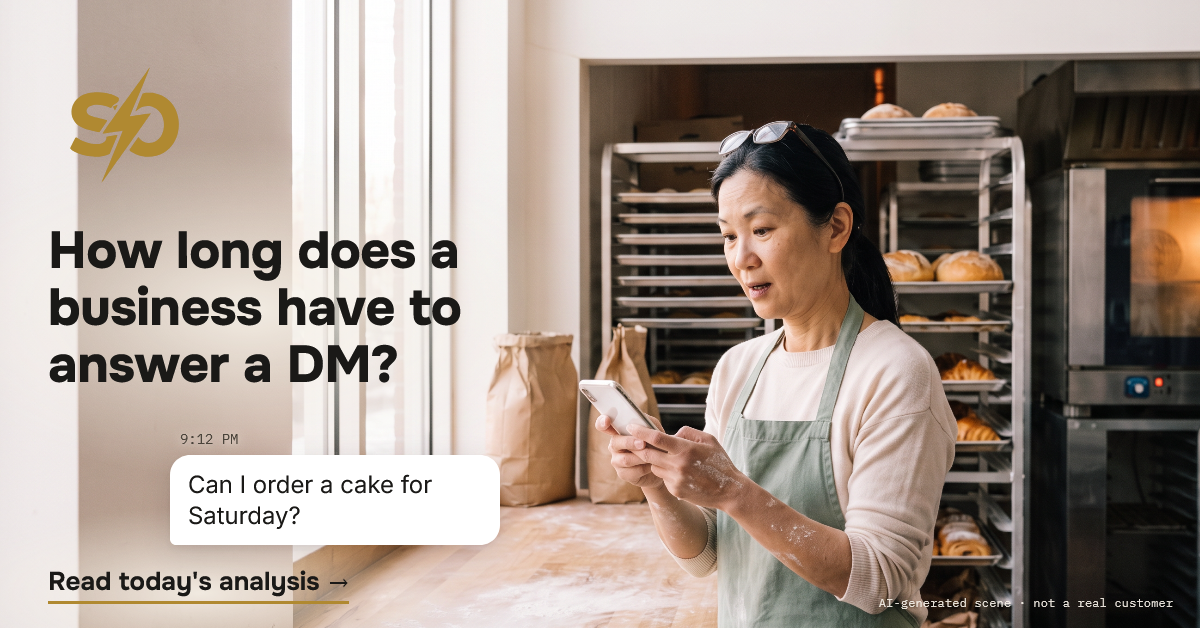
Wednesday, 9:12 p.m., Orlando. Lily Chen shuts the oven door at Chen Family Bakery and takes off her apron. An Instagram message comes in: "Can I order a cake for Saturday? For about twenty people." Her phone is face down next to the flour. Lily will see the message at six in the morning, when she starts the bread.
How long does she have? The platform has an answer, and it's written in its rules. The customer has an answer of her own, and it's shorter.
We read what Meta has changed in its business messaging rules for Messenger and Instagram over the past few months, and how fast it expects a bot to reply.
Chen Family Bakery is our sample business.
📨 The reply window now depends on where the customer came from
In the version of Meta's policy page saved by the Internet Archive in March 2026, the rule was simple: a business has up to 24 hours to respond to a person. Today's version, updated September 28, 2026, works differently. The length of the "standard messaging window" depends on what the person did. Most of the time it's still 24 hours. But if someone tapped an ad that opens Messenger or Instagram Direct and sent the first message, the window can last up to 7 days from that message. The archive doesn't show exactly when that line appeared: somewhere between March and late September. Inside the window a business can reply freely. Outside it, only in a short list of cases Meta spells out.
The window tells you how long you're allowed to wait. It doesn't tell you how long the customer will.
🤖 A bot has a standard: 30 seconds
The same page sets a rule for bots. If a bot is registered as fully automated, it has to respond to anything the person does (a typed message, a button, a menu item) within 30 seconds. Right next to it is a second rule: where the law requires it (Meta names users in California specifically), an automated chat has to say that the person is talking to an automated service. It says so at the start of a conversation, after a long pause, and when a human hands the chat over to automation. Where the law doesn't require it, Meta recommends doing it anyway.
For a bot, the platform's standard is half a minute. Plus honesty: the bot says it's a bot.
📊 Reply time is what owners measure for themselves
On October 14, Meta published a YouGov survey of almost four thousand small business owners in nine Asia-Pacific countries, taken in August and September 2026. It isn't the U.S., but the questions are the same. 84% already use AI. Among those who used it in the past year, 37% use it for customer support and communication. 86% say small businesses need more guidance on how to use it, and half (51%) name cost as the main barrier to training. The same post tells the story of Zayya, an Indonesian modest-fashion brand that cut its reply time to customers from 30–60 minutes to under two.
Owners don't measure the benefit in words. They measure it in minutes to a reply, and you can count those minutes in your own inbox today.
What this means for a shop of five
The platform's rules set a ceiling, not a standard. 24 hours is how long you're allowed to stay quiet, not how long it's wise to. The Saturday cake gets ordered from whoever answered that evening. If an automated assistant answers for you, it has two jobs: answer fast, and say honestly that it's automated. If you answer yourself, you need a plan: who checks the inbox in the evening, and what happens to a question that has no ready answer.
What to take with you
- Open your Instagram and Facebook inboxes, find the oldest unanswered message, and write down how long it has waited.
- Write down the five questions that reach your inbox most often, with a one- or two-line answer to each.
- If you run ads that open Messenger or Direct, remember that the 7-day window is permission, not a reason to wait.
- If a bot or an assistant answers your messages, make its first line say that it's automated.
- Decide today who answers from 6 p.m. to 9 a.m., and write that name down.
What's the oldest unanswered message in your inbox right now?
