
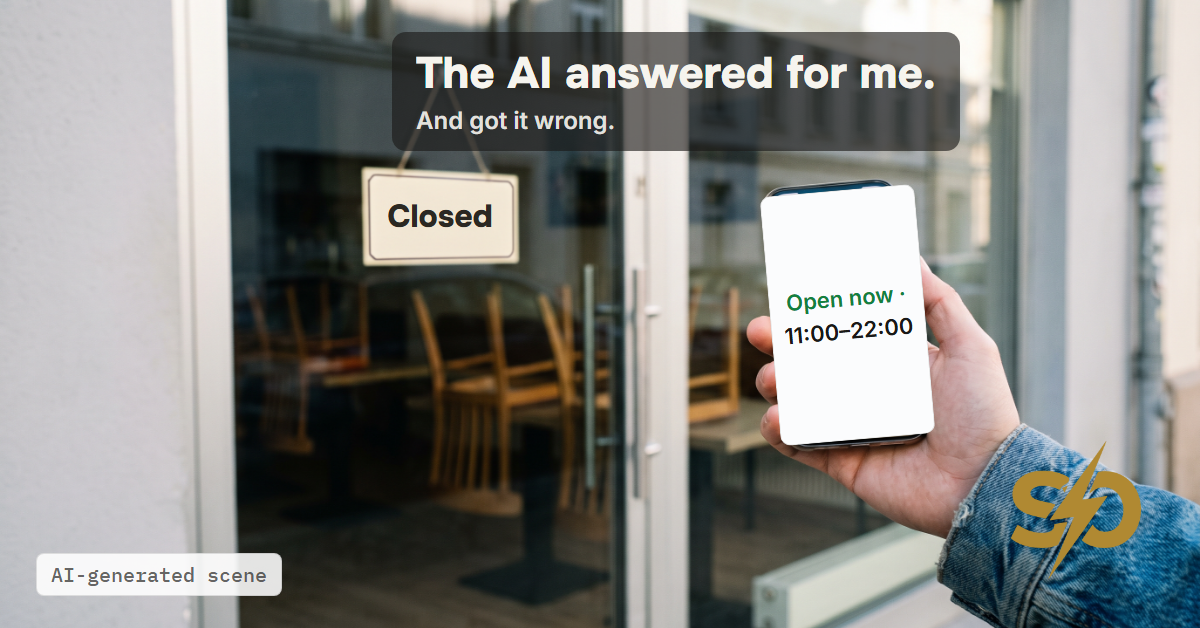
The customer never called. They asked their AI assistant: "restaurant near me, open now, table for two?" The assistant answered with confidence: hours, address, phone. The owner never heard about that conversation. They find out only when the customer arrives at a closed door, or dials someone else's number.
How often those answers are right has been measured, so far only by companies that sell local-search tools. Read the numbers below as theirs.
📞 The phone number is the fact it misses most
Insites compared what ChatGPT said about 10,000 U.S. local businesses with each business's own Google Business Profile, and published the results on July 23. Only 55.58 percent of ChatGPT's results fully matched. The most common mismatch was the phone number: wrong in 30.09 percent of results. Insites adds that part of that comes from call-tracking numbers, which are correct for the business but don't match the listed one. The wrong website came up in 15.59 percent.
Takeaway: in more than four answers out of ten, at least one detail didn't match, and the detail that missed most is the one a customer dials.
🔎 Customers ask, and then they keep looking
In BrightLocal's Local Consumer Review Survey, released March 10 (1,002 U.S. adults), 45 percent said they had used an AI tool for a local business recommendation in the past 12 months, up from 6 percent a year earlier. ChatGPT was the most used, at 31 percent. In a second BrightLocal survey, released July 9 (1,227 people who had searched for a local business in the past three months), AI tools were part of 23 percent of their most recent searches. And AI is rarely the last stop: of the people who started with an AI tool, just 2 percent used nothing else, and 43 percent went on to Google.
Takeaway: the AI's answer is often the first thing a customer reads about you, not the last. If it's wrong, they carry the wrong version into the next search.
🧩 Where the AI gets its facts
From the pages it managed to read. If your hours live in a picture on the website, your Google profile still shows last year's schedule and your social page says something else, the assistant will pick one of the three, or fill the gap itself.
What to take with you
- Ask your own AI assistant about your business today, the way a customer would: the name and the city. Read the answer as a stranger.
- Start with the phone number. In the Insites test it was the detail most often wrong, and it's the easiest to verify.
- Put your hours on the website as text in digits, not as a picture or a PDF.
- Make the three places machines read say the same thing: your website, your Google Business Profile and your social pages. Same hours, same phone, same address.
- Ask again after you change something, and ask more than one assistant. Answers can differ from one try to the next and from one assistant to another.
At SmashOne there is an AI employee whose job is to keep a business's facts identical everywhere people and machines read them. You hire it before you hire a second person, set it up by talking to it in your own ChatGPT, Claude or the Gemini app, and watch it work for our demo businesses, Tampa Pasta House and Casa Lista, before you pay. But ask your AI first: would it answer for you correctly?
