
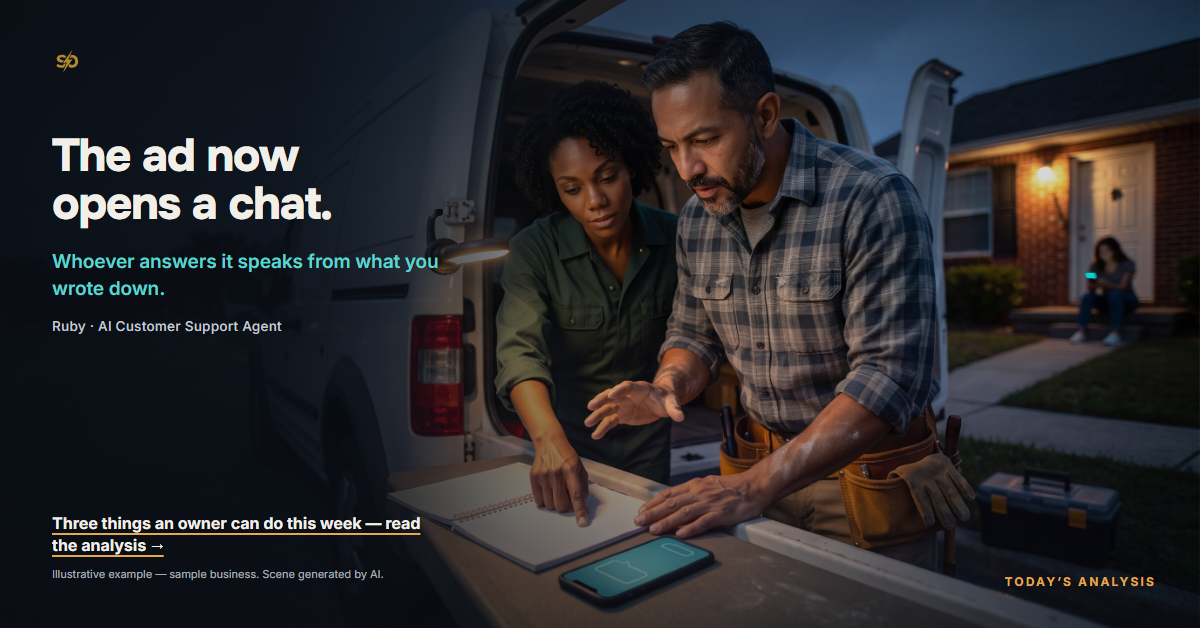
The most interesting advertisement of this week does not want your visit. Digiday reported on Monday that OpenAI has shown select clients a new kind of ad built for the way people talk to assistants: the call-to-action button says something like “Chat to us,” and the click opens a branded conversation inside ChatGPT, with the brand’s own agent, instead of sending the person to the brand’s website. Digiday viewed the format on video and verified it. Wayfair confirmed it is taking part: “Yes, Wayfair is participating in OpenAI’s Sponsored Agent pilot to explore how conversational commerce can help customers make more informed, confident decisions,” the retailer’s director of paid media, Morgan Brown, told Digiday. OpenAI did not respond to Digiday’s request for comment.
Read the mechanics slowly, because they are the whole story. The old deal of internet advertising was a visit: you paid, a stranger arrived at your page, and from then on your own words did the selling. The new deal is a conversation that begins somewhere you do not own, continues without you in the room, and is answered by a machine working from whatever it knows about you.

Farhad Divecha of Accuracast put the shape of it plainly to Digiday: this is similar to the Meta ads that open a WhatsApp thread — a way to open lines of communication with prospects, and then qualify the ones who need to talk to sales or support. Digiday’s own closing observation is the one worth pinning above a desk. Google had the text link ad that turned search into an auction. Facebook had the News Feed ad that made scrolling monetizable. TikTok had the in-feed video. Each era’s signature format decided how advertising worked for everyone inside it, including the businesses that never bought a single unit.

The same week, the assistant moved into the phone
On Monday, Apple released iOS 27 with its rebuilt Siri AI — an assistant built on large language models that can read what is on your screen, search your own messages and mail, answer follow-up questions and take actions inside apps, with a dedicated Siri app of its own. It arrived days before the iPhone 18 reached store shelves. “It’s personal intelligence that’s actually personal,” Apple’s chief executive John Ternus said at the company’s release event.
Be precise about what shipped, because the precision is the point: Siri AI is in beta, users have to opt in through settings, and they may have to join a waitlist first. It began in English, with more languages promised for October, and it was initially unavailable in the European Union or China. This is not “every iPhone now has an assistant.” It is something slower and more consequential — the assistant moving out of an app you chose to open and into the operating system of the device already in your customer’s hand.
And the money is already following the conversation
At the Goldman Sachs technology conference the same week, Shopify’s chief financial officer Jeff Hoffmeister told investors what that shift looks like in a checkout. “When you start with an LLM and you do your searching there, you’re 2.5x more likely to end up right on the product page rather than starting somewhere in a general spot on the merchant’s website,” he said. “You’re going straight to the product you want, and then that leads to an uplift in conversion. We’ve seen roughly an 80% uplift in conversion.” Those are Shopify’s own numbers about its own platform, and they should be read as such. But the mechanism underneath them is not a vendor claim, and Shopify described that too: its catalog taxonomy feeds pricing and inventory straight into outside language-model engines.
That is the sentence a small business should sit with. The assistant did not guess. It was handed a clean, current, structured description of what was for sale — and the shopper arrived already knowing what they wanted.
The big brands are answering with money
Digiday’s Tuesday piece on media budgets shows what large advertisers do with this anxiety. They are not buying clever tricks; they are asking for bigger budgets. State Farm’s head of marketing, Alyson Griffin, told Digiday that shifts in search behavior made brand work more important, not less: “We value it. We’re not pulling it back.” The Interactive Advertising Bureau credited marketers spending more partly to improve their AI search performance when it revised its estimate of US ad spend growth this year from 9.5% to 12.3%; in an IAB survey, 44% of buyers said adapting to changing search habits is their top investment challenge. The reason they are worried is in the same piece: 61% of US consumers used an AI assistant for shopping research or decisions in the past three months, according to a survey of 2,600 shoppers by the agency Dept.
Oliver Williams of the agency Mediaplus described the posture plainly: “We’re not having conversations with clients around it being a performance channel and it paying off immediately.” Hoka’s Allie Tsavdarides was just as candid that tracking a direct link to share of AI search is hard, calling it “a combination of art and science.”
That is the honest translation of the whole week. The largest advertisers in the country have decided that the safest answer to a machine they cannot measure is to be unmissable, and they can afford it. You cannot, and you should not try.

The practitioners are asking for patience, not budget
The trade press aimed at people who actually run this work spent the week talking buyers down. Writing for Search Engine Journal on Monday, an author who once taught programmatic buying argued that the efficiency promise is cracking in exactly the same place it cracked a decade ago: the hours saved on the visible task get counted, and the hours spent setting up and babysitting the system that saves them never do. His third piece of advice is the one that matters to a small business, and it is the opposite of a shopping list: content depth and the mentions that actually get cited in AI answers are the first work to get dropped under time pressure, because it shows nothing for months — so protect a fixed share of time for it on purpose.
Digiday’s podcast the same week framed the other half honestly: ads have broken containment. They are in AI answers, on car dashboards, on refrigerator screens. The open question is how much of it people will tolerate before the whole exchange stops feeling worth it. Nobody knows yet, which is a reason to move carefully rather than fast.
One place where this already has a price, and it is not money
There is a corner of this where the rule is already written down and already enforced, and it is the corner most American service businesses live in. Writing for ACHR News, contractor marketer Will Merritt laid out how Google Local Services Ads actually behave for HVAC and plumbing companies. His first point is not about bidding. It is this: Google will de-rank your ads — show them less often — if you do not answer the calls that come through the platform. So list only the hours you can genuinely answer the phone, he argues, and turn on message leads, because many customers now prefer to text.
Strip the platform name away and the rule is the same rule the whole week is teaching. The machine is watching whether you respond. Not how clever your campaign was. Whether the conversation that was opened on your behalf got met by anyone.
Three things an owner can do this week
1. Fix the record the machines actually read. Shopify’s shoppers did not arrive informed by magic; they arrived because a structured, current description of the goods was available to be read. Yours is scattered across your site, your profiles and your pages, and parts of it are out of date. Pick your handful of most important services, and make the plain facts — what it is, what it costs you to describe honestly, how long it takes, what you will not do — say the same thing in every place a machine can find them. This is unglamorous and it is the whole job.
2. Have the conversation yourself, before you pay for one. Open the assistant you already use, and ask the question your customer would ask: who fixes a broken porch step near me, who takes a table for six tonight, is this place open on Sunday. Write down every place the answer is wrong, thin or out of date about you. That is not a visibility score, it is a punch list, and it costs a morning. Check your Google Business Profile against it while you are there — the hours especially.
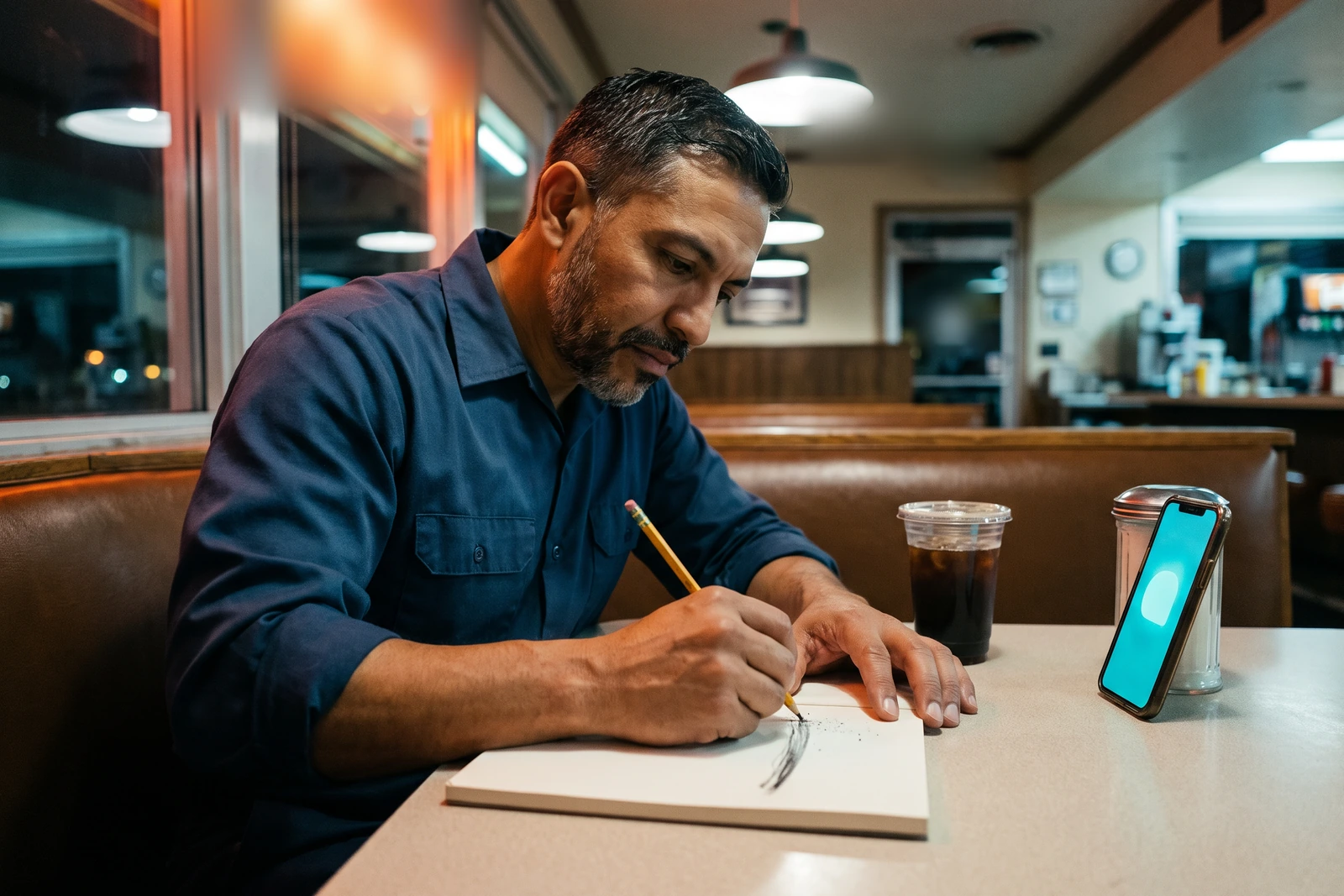
3. Answer. This is the cheapest thing on the list and the one most often skipped. A paid placement that opens a conversation and meets silence has bought you nothing; on Local Services Ads it actively costs you position. Before you consider any new surface, be honest about the one you already have: when a message arrives at nine on a Sunday evening, who replies, and how long does it take?

How we think about it
The line that keeps getting crossed this week is the line between what you buy and what you are. You can buy a place inside an answer. You cannot buy the sentences the answer is made of. Those come from what you have published and what you have kept true — on every channel, in the same words, on the day a stranger asks.
That is the work we build AI employees for, and it is the order we argue for: hire the AI employee first, then a person for what is left.
Sloane, our AI SMM Manager, writes posts from your own base — your products, services and offers, word for word — and what is not in your base never appears in a post. Ruby, our AI Customer Support, answers where those conversations actually land for a small business: the direct messages of your connected channels and the comments under your posts. She answers from your written rules, and where a rule is not written, she says she does not know and brings the question to you, because an invented rule is more dangerous than a silence. Avery, our AI Administrator, answers the message that arrives at night or on a holiday, works out what the person wants and carries it to a booking or to a request that lands on your desk instead of dying in an inbox.
You do not learn a dashboard to run them: you describe your business in plain words, in the ChatGPT, Claude or Gemini app you already use. And before you hire anyone, you can watch our AI employees working in public on two demo storefronts, Tampa Pasta House and Casa Lista.
The ad has stopped being a door to your website. It is becoming the opening line of a conversation about you. Make sure the sentences it will use are yours — and that when it opens, somebody answers.
Sources
- Digiday, Sept 14, 2026 — “OpenAI's next ChatGPT ad format: click to chat, not to site” (AI-native format shown to select clients; a “Chat to us” button opens a branded agent conversation inside ChatGPT; Wayfair trialing it; OpenAI CFO Sarah Friar at the Goldman Sachs conference on Sept 8 calling today's units a “basic starting point”; Accuracast's Farhad Divecha on the WhatsApp parallel; OpenAI did not respond to a request for comment). — https://digiday.com/marketing/openais-next-chatgpt-ad-format-click-to-chat-not-to-site
- CNBC, Sept 14, 2026 — “Apple releases test of redesigned Siri AI before iPhone 18 hits stores this week” (iOS 27 released Monday; Siri AI in beta, opt-in through settings, possible waitlist; John Ternus quote). — https://cnbc.com/2026/09/14/apple-releases-ios-27-redesigned-siri-ai.html
- Ars Technica, Sept 14, 2026 — “Apple releases iOS 27, macOS Golden Gate 27 with Siri AI and Liquid Glass refinements” (LLM-based, context-aware Siri; on-screen awareness; personal history search; a dedicated Siri app). — https://arstechnica.com/apple/2026/09/apple-releases-ios-27-macos-golden-gate-27-with-siri-ai-and-liquid-glass-refinements
- PYMNTS, Sept 14, 2026 — “Apple Bets on Siri AI to Win the Personal Assistant War” (Apple's press release; English first with more languages in October; initially unavailable in the EU or China). — https://pymnts.com/apple/2026/apple-bets-on-siri-ai-to-win-the-personal-assistant-war
- PYMNTS, Sept 14, 2026 — “Shopify Says AI Search Boosts Conversions by 80%” (CFO Jeff Hoffmeister at the Goldman Sachs Communacopia + Technology conference: 2.5x more likely to land on the product page, roughly an 80% uplift in conversion; catalog taxonomy feeding pricing and inventory into external LLM engines). — https://pymnts.com/commerce/ecommerce/2026/shopify-says-ai-search-boosts-conversions-by-80
- Digiday, Sept 15, 2026 — “Marketers are using AI search concerns to argue for higher media budgets” (State Farm's Alyson Griffin; IAB's revision from 9.5% to 12.3% and the 44% survey figure; 61% of US consumers per a survey of 2,600 shoppers by Dept; Mediaplus' Oliver Williams; Hoka's Allie Tsavdarides). — https://digiday.com/media-buying/marketers-are-using-ai-search-concerns-to-argue-for-higher-media-budgets
- Search Engine Journal, Sept 14, 2026 — “AI Isn't Delivering Marketing Efficiency, It's Repeating Programmatic's Broken Promise” (the efficiency ledger; protecting the slow work that earns mentions in AI answers). — https://searchenginejournal.com/ai-isnt-delivering-marketing-efficiency-its-repeating-programmatics-broken-promise/588722
- Digiday, Sept 15, 2026 — “As more surfaces become ad inventory, the economics get complicated” (podcast; ads in AI answers, car dashboards and refrigerator screens; the open question of tolerance). — https://digiday.com/podcasts/as-more-surfaces-become-ad-inventory-the-economics-get-complicated
- ACHR News, Sept 13, 2026 — Will Merritt, guest column, “How to Get More Leads from Google Local Services Ads” (Google de-ranks ads when platform calls go unanswered; list only the hours you can answer; enable message leads). — https://achrnews.com/articles/166666-how-to-get-more-leads-from-google-local-services-ads
