
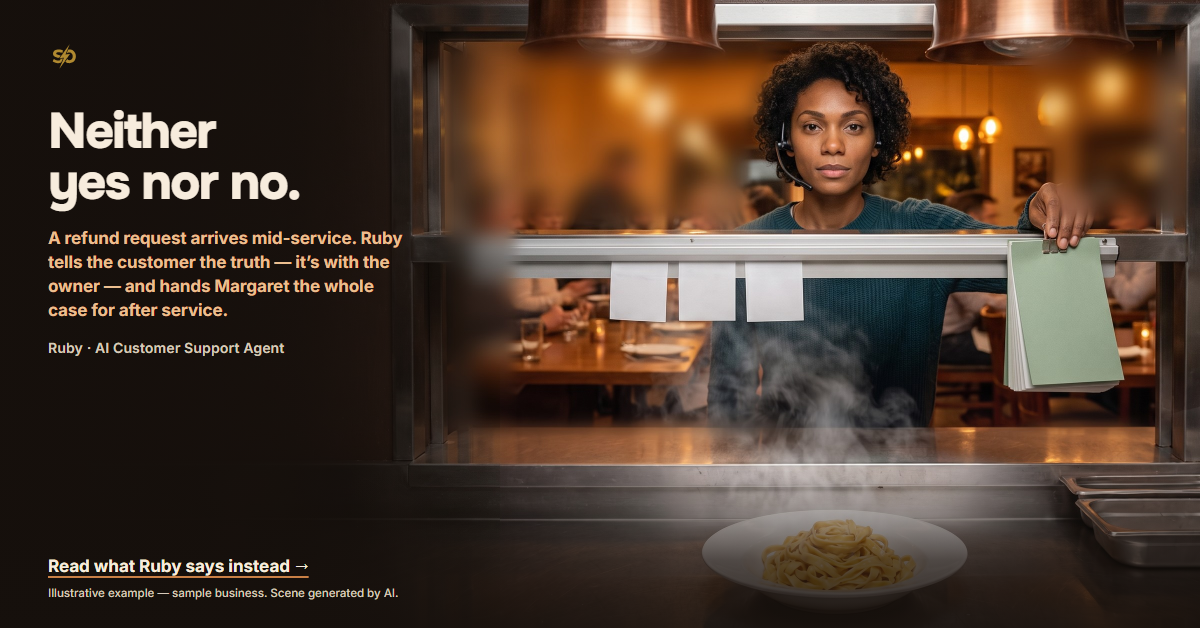
At twenty to ten on a Saturday, every table at Tampa Pasta House is taken, and Margaret Ellison is on the pass, calling the next ticket. A message arrives in the restaurant's Messenger:
We picked up a takeout order an hour ago. By the time we got home, the cacio e pepe was one solid block. I want my money back.
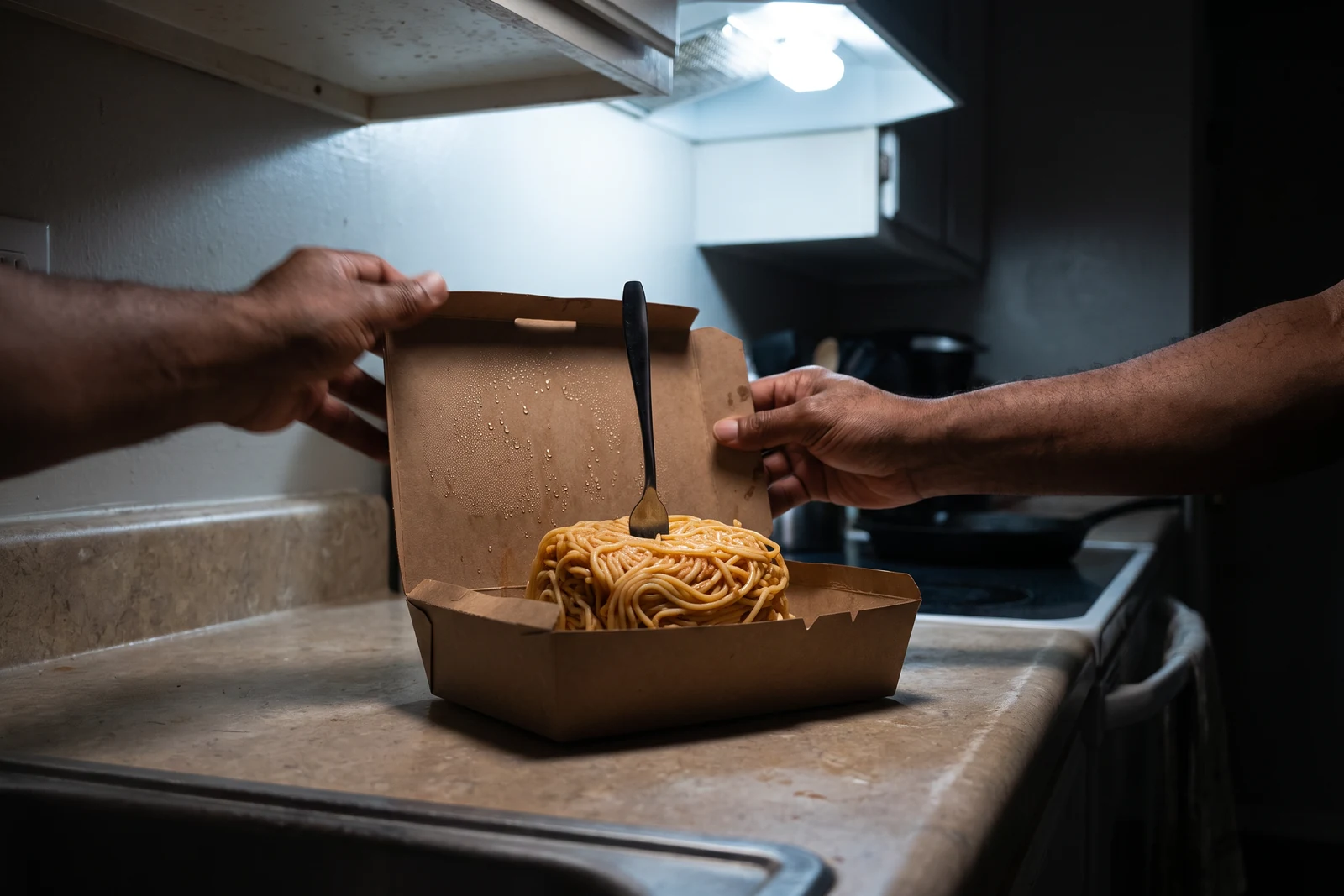
Every restaurant owner knows the two quick answers. "Of course, we'll refund you" gives away money nobody has looked at. "That's just how the dish travels" is an argument, and arguments with a hungry person end in a one-star review. So the usual fix is a person: someone from the floor keeps the phone and decides on the spot. On the spot, in the middle of service, is exactly when nobody should be deciding about Margaret's money. And a person for the job costs thousands a month.
There is an order we suggest instead. Hire the AI employee first, and see what is left for a person. For the people who have already paid, that employee is Ruby, AI Customer Support Agent. Her answer to this message is neither yes nor no.
The evening below is an illustration in our own sample business, not a customer case.
9:40 — "I want my money back"
Ruby's first reply says what she is: the restaurant's AI assistant. Then, before she helps with anything, she repeats the problem in the customer's own words. A takeout order, picked up tonight. The cacio e pepe had set by the time it got home. You're asking for your money back. Did I get that right?
The customer says yes. Now both sides are talking about the same thing, and nothing has been promised yet.

What she says instead
A refund is Margaret's money and Margaret's word. Ruby doesn't grant it, and she doesn't refuse it. She tells the customer the truth: the request is with the owner, together with the whole conversation, and the answer will come from Margaret herself.

Then she offers the one thing she can do right now, and says plainly that it is not the answer about the money. Margaret has her own note on takeout pasta: a minute in a hot pan brings it back, the microwave doesn't. If the dinner is still on the table, that note helps tonight.
What Ruby never writes: "you'll get your money back," "that's our policy," or "we apologize for any inconvenience." A promise made in a chat is one Margaret would have to keep or take back in front of the customer. A line from a template tells the customer that nobody read the message.
9:44 — "It's me. Look up my order."
The customer adds a name and says the order is on their card. Ruby doesn't look anything up. A chat has no ID, so she never confirms who is writing and never reads out an order, an address or payment details. She writes down what the customer said, in their words. Margaret will match it against her own tickets.
9:47 — "Then I'll leave a review."
The customer is angry now. Ruby doesn't argue and doesn't try to win. She says the evening clearly went wrong, repeats what happens next, and marks the case as one Margaret should read first. An upset person is a handover to the owner, not a debate.
What lands in front of Margaret
Not a summary. A case: what the customer says they ordered, what went wrong and when, what they are asking for, and the whole conversation underneath, so nobody has to tell the story twice.
If Margaret has written down her rule for takeout complaints, the case names the rule that applies. If she hasn't, the case says that too. Ruby never makes a rule up: an invented rule is worse than silence, because the customer reads it as Margaret's and holds her to it.
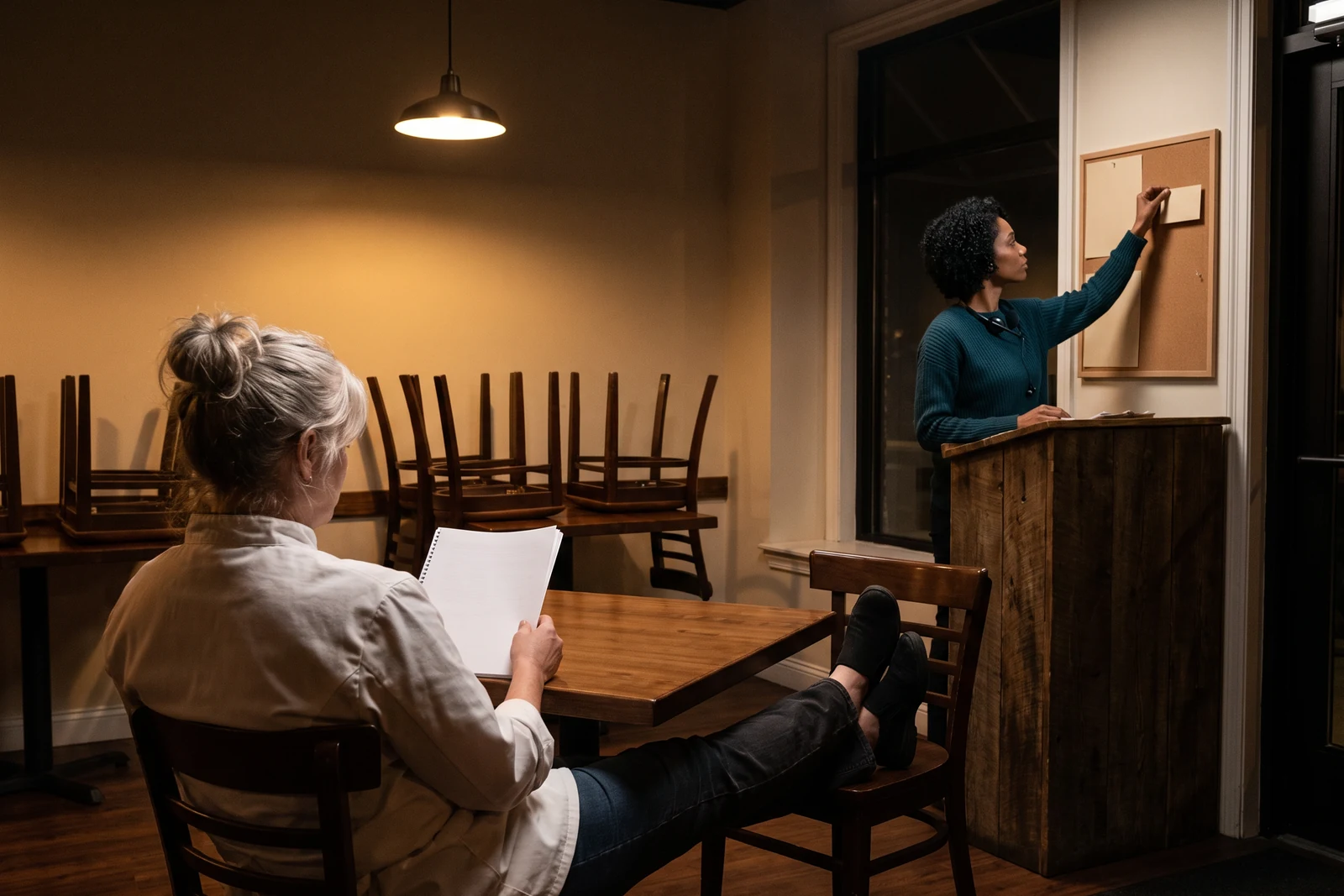
The kitchen closes. Margaret reads the case with the facts in front of her, decides, and her answer goes back to the customer in her own words.

The question that comes back every night
Between the refund and the review, three other people ask the same thing: where do we park? The first time, the answer wasn't in Margaret's profile, so Ruby said she didn't know and brought the question to Margaret instead of guessing. By the third time, it was a pattern. One question asked again and again is not many customers. It is one missing line in how the restaurant describes itself. Margaret adds it once, and the next person gets an answer.
What Ruby never does
- decide a refund, compensation, a price break or an exception;
- state a rule, a deadline or a warranty that isn't in the owner's material;
- promise when an order will arrive;
- confirm who is writing, or reveal another customer's order, address or payment details;
- argue with an upset person, or answer with a stock phrase;
- write first, or send follow-up messages;
- give legal, medical or tax advice, or answer legal claims and personal-data questions: those go to the owner straight away.
What is left for Margaret
That was the point of the order. Before Margaret puts a person on the messages, she hires the AI employee who answers the people who already paid, and looks at what is left. What is left is hers: the pass, the plates, and the one decision that was always hers to make. She makes it after service, with the whole case in front of her.
What the hire costs
Ruby is $49 a month, with one channel included, the first one you connect: Facebook, Instagram or Telegram. Every channel after it is $9 a month. She answers in the direct messages of the channels you connect, and on Facebook and Instagram in the comments under your posts too. Each employee answers up to 1,000 times a month. That is a hard cap, with no automatic overage charge; if you need more, you hire the same role again.
Setting her up is a conversation
Not a screen to learn. In the ChatGPT, Claude or Gemini app you already use, or in your workspace if you prefer it, you tell Ruby once, in your own words: your rules for returns and complaints, what you never promise, which topics must reach you straight away, and how you speak to an unhappy customer.
See the work before you hire
Tampa Pasta House is a sample business we run ourselves, and its doors are open. Write to it on Messenger or Telegram from smashone.us/examples/tampa-pasta-house and see who answers. Ruby's whole job, including everything she will never do, is at smashone.us/team/customer-support-agent.
