
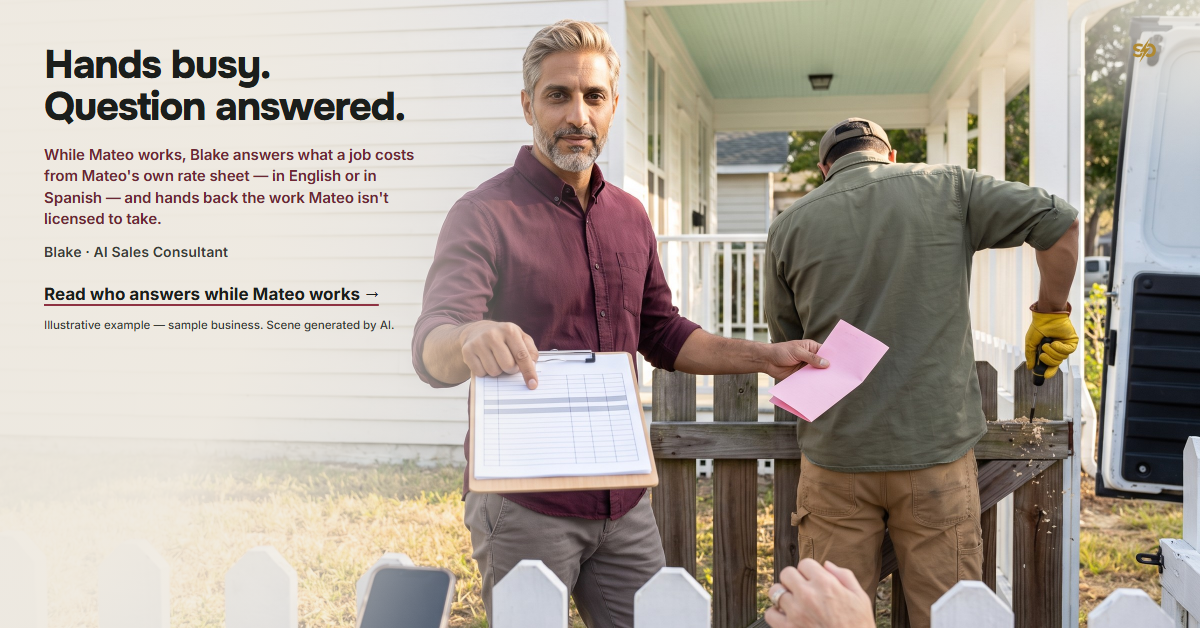
At a quarter past seven on a Tuesday, Mateo Salgado is holding a garden gate up with his shoulder and driving a hinge screw with his free hand. His phone buzzes in his back pocket. It buzzes again.
Mateo runs Casa Lista Home Repair on his own in Tampa: one man, one van, jobs that can be finished in a single visit. The message says: How much to fix a kitchen faucet that drips? Can you come this week? By the time the gate swings true and he wipes his hands, the person who wrote has asked two other handymen. One of them answered.

Every tradesman who works alone reaches the same thought sooner or later: I need someone to answer while I work. A person for that costs thousands a month.
There is an order we suggest instead. Hire the AI employee first, and see what is left for a person. For Mateo, that employee is Blake, AI Sales Consultant: the one who talks to people while they are still choosing.
The morning below is an illustration in our own sample business, not a customer case.
7:15 — "How much to fix a faucet?"
Blake doesn't open with a number. He asks first. Is it dripping from the spout or leaking at the base? How old is it? A price given before the question is a guess, and a guess is what the customer quotes back at Mateo in the driveway.
The faucet is fifteen years old. Blake lays out the two lines on Mateo's rate sheet, repairing the cartridge and replacing the faucet, and passes on Mateo's own note: on a faucet that old, a new cartridge holds for months and a new faucet holds for years. He says which one fits. When the cheaper line is the right one, he says that too. A salesperson who always points at the bigger job stops being trusted by the second call.

The number is a line, not an estimate
Every figure Blake gives is a line from Mateo's rate sheet. He doesn't calculate it, round it or "ballpark" it. When the customer adds a second small job, the whole list is counted again from the sheet, and the total she sees is the server's arithmetic, not a number made up in a chat. If something isn't on the sheet, there is no number. Blake says so and passes the question to Mateo.
7:24 — "¿Cuánto cuesta arreglar un portón?"
The next message is from a neighbor, in Spanish, about a gate. Blake answers in Spanish. Nobody set that up. The number in his answer is the same number an English speaker would get, and when her son follows up in English, Blake switches back.

In his first reply to each of them, Blake says what he is: the business's AI assistant. He never pretends to be Mateo.
7:31 — "Can you also redo the wiring in the kitchen?"
This is the message that decides whether Mateo can trust whoever answers for him.
Mateo is a handyman without a contractor's license, and he says so before he comes out. Rewiring a kitchen is licensed work. Blake doesn't quote it, doesn't say "probably," and doesn't offer to break it into two smaller invoices that each look allowed. He tells the customer plainly that this job needs a licensed professional and offers to put her in touch with Mateo, who works with a licensed electrician on exactly these jobs.

A job quoted that the business has no right to take is not a sale. It is a problem with Mateo's name on it.
The yes, and then Mateo's word
Back to the faucet. Blake shows the exact list and the total. The job request is created only after a clear "yes" in a separate message, and if the list changed in between, that "yes" doesn't count and the total is shown again.
Then it goes to Mateo, with the whole conversation attached: what she asked, what she was told, why the replacement. The visit time is his to confirm, not Blake's to promise. On the tailgate, between two jobs, Mateo reads it and says yes.

What he never gives away
"Can you do it for less if I pay cash?" Blake doesn't offer a lower price, a deal or a special condition. He offers only the promotions Mateo has set up. A request for anything else goes to Mateo, written down in the customer's own words, because a concession made in a chat is a concession Mateo would then have to honor or take back at the door.
Money is never Blake's. How Mateo takes payment is Mateo's business. And when someone writes "no thanks," the conversation is over. Blake never writes first and never follows up with someone who said no.
What Blake never does
- names a price that isn't on the rate sheet, or works one out himself;
- quotes work the business has no right to do, or splits it into two invoices;
- invents a lower price, a deal or a condition;
- says a job is booked before Mateo confirms it, or promises a time;
- takes payment, or decides refunds;
- writes first, or chases a person who declined;
- answers questions about personal data or legal claims: those go to Mateo at once.
What is left for Mateo
That was the point of the order. Before Mateo hires a person to answer, he hires the AI employee who answers, and looks at what is left. What is left is his: the gate, the faucet, the handshake at the door, and the one question Blake passed back because it needed Mateo.
What the hire costs
Blake is $49 a month, with one channel included — the first one you connect. Every channel after it is $9 a month. Each employee answers up to 1,000 times a month. That is a hard cap, with no automatic overage charge; if you need more, you hire the same role again.
Setting him up is a conversation
Not a screen to learn. In the ChatGPT, Claude or Gemini app you already use, or in your workspace if you prefer it, you tell Blake what you fix and what you don't, how your jobs differ, what customers hesitate about, and what you never promise.
See the work before you hire
Casa Lista Home Repair is a sample business we run ourselves, and its doors are open. Write to it on Messenger or Telegram from smashone.us/examples/casa-lista and ask what a job costs, in English or in Spanish, and see who answers. Before you hire him, you can also watch Blake describe his own job, including where he stops, at smashone.us/team/sales-consultant.
