
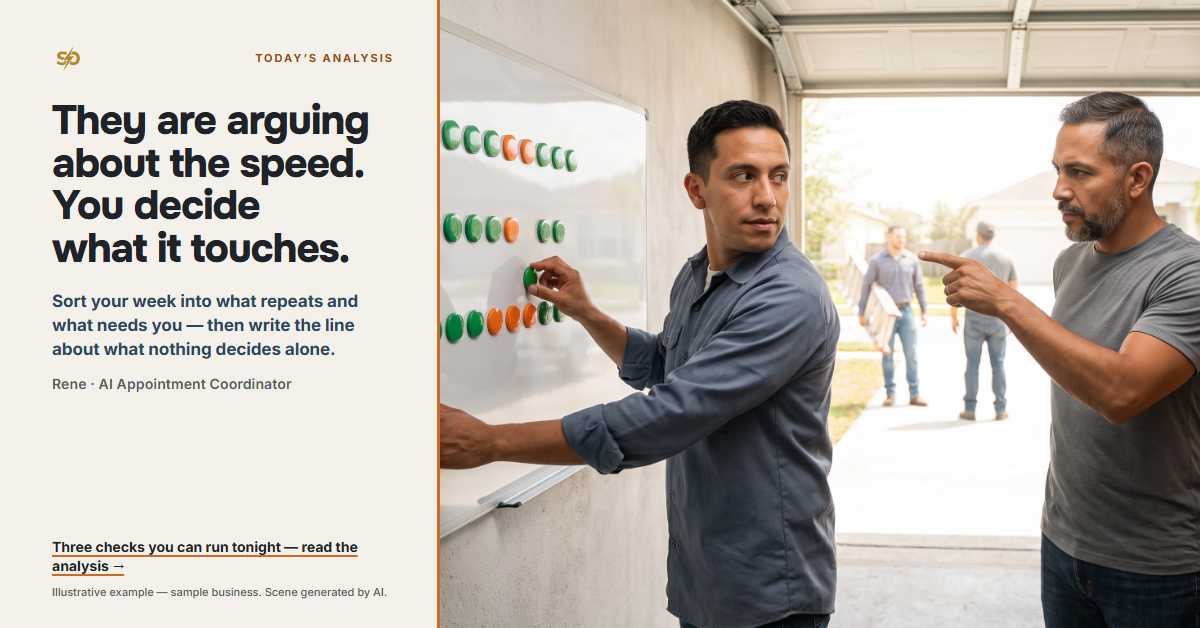
Over the weekend, the people who build the largest AI models asked, out loud, to be slowed down. By Tuesday the argument was not about whether they should slow down. It was about whether they meant it.
Almost none of that reaches your counter. One sentence from it does, and it is worth the twenty minutes this piece will cost you.
Here is what was actually said, because the version that reached most people was a headline about robots.
The Verge’s Hayden Field reported on Sept. 14 that OpenAI’s Sam Altman, Anthropic’s Dario Amodei, Google DeepMind cofounder Demis Hassabis and Elon Musk had loosely agreed over the weekend to what they call pacing the frontier: outside auditors with, in Amodei’s phrasing, employee-like access inside the labs; common safety standards; and an attempt at an international agreement. Critics answered within hours that a handful of dominant companies writing the rules for everyone else has another name, and some used it: cartel.
Field’s piece is worth reading in full because it does not take a side. She quotes people who have been asking the labs to do exactly this for years and who now doubt it will amount to much — “they’ll just bring in some external auditors, do a bunch of safety paperwork… but at the end of the day, it actually won’t slow them down very much at all,” said Daniel Kokotajlo, a former OpenAI employee who now runs the AI Futures Project — alongside others who called the agreement one of the best things to happen to safety in a long time if it actually happens.
Altman spelled out his own position the next day. CNBC’s Kai Nicol-Schwarz reported him saying he welcomes a federal framework with consistent safety requirements for frontier labs, that “no amount of American competitive pressure should justify recklessness” — and then the qualification that matters more than the headline: “When we talk about 'pacing,' we do not mean 'stopping.' Progress has been rapid and will continue to be.”
The other camp said the quiet part clearly, too
Nvidia’s Jensen Huang, speaking at a conference late on Sept. 15 and reported by TechCrunch’s Julie Bort, refused the whole framing. AI is not an alien mind, he said; it is hardware and software built by people, so people and existing law can handle it. “Safety is an engineering problem, not a legal one.” No new rules are needed, in his view, because the market already punishes a company that ships something unsafe.
Bort does not let that stand unexamined — she notes, dryly, that a man whose company sells the hardware of the boom has an obvious reason to dislike anything that slows it, and she lists products from other industries that shipped broken with the best intentions. Fair. But listen to how Huang finished the thought:
“If you build a product or a service, and you’re not confident in its functionality, capability, or safety, then don’t release it… You pace yourself until you are confident you’re releasing something that the market would appreciate… But if you feel at any given point in time the company’s out of control, or the product’s not going to be safe, take a pause and make sure you get it right.”
Read that beside Amodei’s line, as reported by CNBC — that self-improving AI, “left unchecked, could outrun our ability to understand and control these systems, and so must be pursued very carefully, if at all” — and something odd appears. The two men are on opposite sides of a public fight about regulation, and they are giving the same instruction: do not put a thing in front of people until you can stand behind it; when you cannot, stop that part.
They disagree about who enforces it. They do not disagree about the rule. And the rule is the only part of this week that transfers to a business with a small team and a van.

What actually reaches your counter
Not superintelligence. Something much smaller and already here.
The most useful sentence of the whole argument came from one of its critics. Writing up the rebuttals on Sept. 15, the-decoder’s Matthias Bastian quotes Cohere CEO Aidan Gomez — who calls the slowdown proposal “a wolf in sheep’s clothing, a cartel by any other name” — making a point that has nothing to do with market share: while the industry debates hypothetical superintelligence, “voice cloning tools cheaper than a phone bill can empty a pensioner’s account in minutes.”
That is the shape of the risk that arrives at a small business. Not a machine that outthinks humanity. A cheap tool, used badly, on a phone line or an inbox that belongs to somebody with no security department. In this column on Wednesday and Thursday of last week we said the same thing from two other directions: the conversation about your business now starts somewhere you do not own, and being answered is not the same as being finished. This is the third face of it.
And there is a second thing already arriving, which almost nobody framed as small-business news.
PYMNTS reported on Sept. 15 that Nvidia, Palantir, Booz Allen Hamilton and Novo Nordisk have all drawn hard boundaries around where Anthropic’s most advanced models may be used — not because of quality, but because of the terms attached to data. Nvidia keeps the model on lower-stakes work and uses its own models for anything sensitive; its vice president of enterprise AI is quoted saying zero data retention “should be on by default.” Booz Allen barred it from work touching the software it sells to clients. Palantir will not offer the model through its platform at all until it gets an irrevocable guarantee. A large utility, PYMNTS reports, scrapped a pilot on core infrastructure for the same reason. Anthropic has moved to meet the objection, announcing on Sept. 1 an arrangement that keeps retained safety data inside the customer’s own cloud, under the customer’s own keys.
The publication’s conclusion is the sentence to copy out: the best model will not get the most sensitive work if a buyer cannot control where its data goes.
You will never negotiate a data-retention clause with a frontier lab. You do not have to. The lesson underneath it is the same at every size: the terms of a tool can change while you are using it, and the question is what that costs you when it happens.
The people who buy AI for a living did not stop. They wrote a list
This is the part of the week that translates almost line by line.
CIO Dive’s Roberto Torres asked analysts what a slowdown means for companies that have already built plans around a steady stream of better models. Gartner’s Arun Chandrasekaran was blunt about the effect: “I believe this creates more uncertainty about the future. CIOs so far have assumed a certain cadence of innovation in the model ecosystem… and now this creates a little bit more confusion in terms of what the pace of release is going to be.”
Nobody in the piece recommends waiting. What they recommend is being able to move. Mark Tauschek of Info-Tech Research Group told CIO Dive that IT leaders need “independently verified evidence, contractual notification and exit rights, model-specific deployment gates, and a tested way to stop or replace a system when the vendor’s controls, policies or risk profile change.” Among his preventive steps: a gate that makes security, privacy, legal and the business owner review a system before it goes into full use.
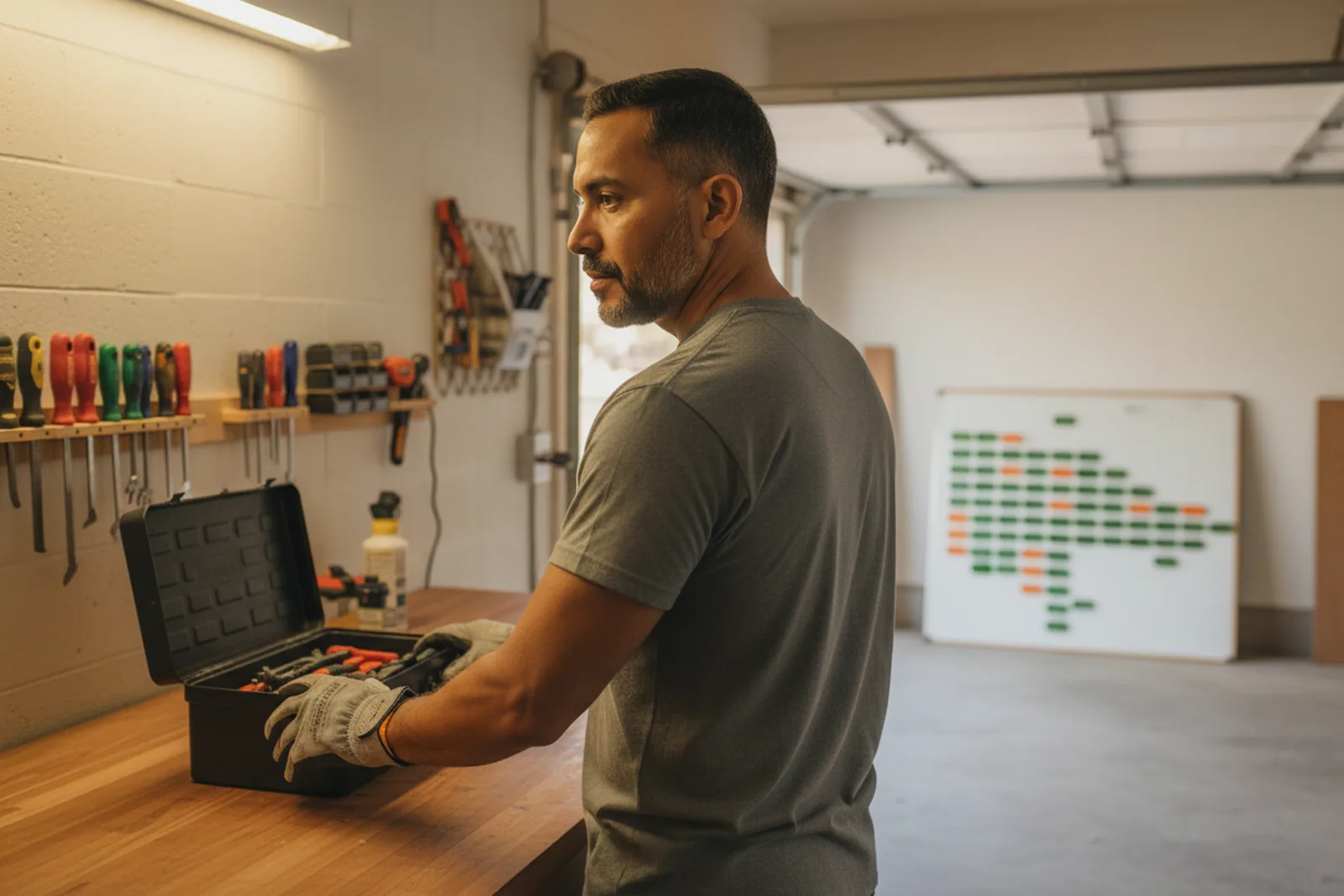
Strip out the vocabulary a small business does not have — no procurement, no legal team, no deployment gate — and three plain requirements are left standing. Know which parts of your week a machine now touches. Keep the material it works from where you can hand it to something else. Decide in advance what it is never allowed to do alone. That is the same list Tauschek gave, written for a business where the security team, the legal team and the business owner are the same person in the same chair.
Which work is it, though
Here the week produced something you can do with a pen tonight.
Writing in Entrepreneur on Sept. 15, Meghna Deshraj proposes a test for a question that predates AI: before you approve a hire, write down the ten things you expect that person to do — not the title, the actual recurring work — and sort each one into four buckets. Judgment: decisions with consequences, ambiguity or accountability. Relationship: work where trust is part of the value. Repetition: high-frequency work with stable rules — her examples are reminders, routine follow-ups, scheduling, data entry, status updates, templated messages. Coordination: work that exists only because systems or people are disconnected — copying information between tools, chasing approvals, asking the same status question again.
Then the rule: if the bottleneck is judgment or relationship work, hire or develop a person. If it is repetition, test automation before you add permanent headcount. If it is coordination, redesign the process first, because automation amplifies process design — “if ownership is fuzzy and the data is wrong, automation makes the confusion faster.” Her line for the whole exercise is the one worth pinning up: a job description should not be a storage unit for broken workflows.
Two of her other points survive the trip to a smaller business intact. First, scale automation by the cost of failure, not by how repetitive a task looks: a missed social post and a missed patient message are not the same risk, and the higher the consequence, the more explicit the owner review and the accountable owner must be. Second, do not measure the tool by how often it gets used — baseline the workflow first, then ask whether the same quality survives twice the volume. If it is used constantly and nothing improves, you have adoption without value.
The same author made a related point in the same publication the day before, and it is fair to say it is one practitioner’s argument rather than two: the most valuable material about what your customers actually want is already inside your business, in the conversations you have already had, and the mistake is outsourcing the definition of it to whoever sells you a dashboard.
Three checks an owner can run tonight
1. Sort one week into the four buckets. Take the job you are drowning in — or the hire you were about to make — and write down ten recurring tasks. Mark each one J, R, P or C: judgment, relationship, repetition, coordination. Do not start with tools. The repetition list is what a machine can hold; the coordination list is usually a process problem wearing a costume; the judgment and relationship lists are the job you actually need a person for. Most owners find that the thing exhausting them is three P tasks and one C task, not a missing employee.
2. Get your own material out of the tool and into your own document. One page or one file: your hours, including the odd ones; how long each job actually takes; what you do not do; your rule for deposits, cancellations and rescheduling; the sentence you use when you cannot help someone. The test is simple and slightly uncomfortable — if you had to explain your business to a new assistant tomorrow morning, could you do it in one evening from something you already have written down? If the answer is no, the material lives inside whatever tool you happen to be using, and the day that tool changes its terms — as terms did change, this week, for some of the largest buyers in the world — you are rebuilding from memory.
3. Write the line about what nothing decides alone. One sentence, on paper, where whoever works your counter can see it. Money is the usual one: no discount, no refund, no exception to your own rule without you. Identity is the second: nobody is who they say they are on a phone call or in a chat. Promises are the third: no delivery date, no guarantee, no “we can do that” about work you have not looked at. Scale it by the cost of being wrong, exactly as the four-bucket test says — the higher the consequence, the more explicit the name of the person who owns the outcome.

None of the three requires a budget, a vendor, or an opinion about the speed limit.
How we think about it
The argument this week was loud because the stakes at the top of the industry genuinely are large, and because the public part of it — hearings, posts, rebuttals from other countries — will not be settled in time to matter to your Tuesday. We are not going to pretend to adjudicate it.
What we take from it is the sentence both camps agreed on without noticing: do not put a thing in front of people until you can stand behind it. That is the standard we build AI employees against, and it is the order we argue for: hire the AI employee first, then a person for what is left.
Rene, our AI appointment coordinator, is what the repetition bucket looks like when somebody builds it on purpose. He answers the moment somebody asks for a time — at midnight, on a Sunday, in the forty minutes you are under a sink. And every time slot he offers comes out of your own profile: your hours, in your timezone, with the length you said each job takes. When a customer says “tomorrow,” he reads back which day that is for your business before anything is written down, because a booking made in the wrong timezone is the most expensive kind of politeness. He holds a booking only after a clear yes, and the confirmation names the service, the time and the person. He will not put two people in the same hour even when he is rushed, and he keeps the gaps you told him to keep. He reminds the evening before and again on the morning of. When somebody cancels, the freed hour goes back on the board instead of quietly disappearing. When you are full, he says so and offers the next open times instead of sending people away. And he answers in the language the customer wrote in.
Then the boundaries, which are the part that belongs to this week’s subject. He quotes a price, an address or a service only from your catalog; when the answer is missing, he says so. When somebody is upset, or asks for you, he stops selling time and hands the thread over. Every change he makes is written down for you, and what he learns about your customers stays in your workspace, not only with him.

Blake, our AI sales consultant, holds the other line — the one this week’s four-bucket test warns about. The test says relationship work loses value when it is treated as a pure efficiency problem, and we agree, which is why Blake does not close your deals. He talks to the person who is still choosing, out of your catalog and your own answers to the doubts you already know by heart; he asks what the person is trying to get done before he recommends anything; he takes a price from your catalog line or names none at all. He does not bargain. A discount, a special condition, a “just for today” is your word and your money, and a concession made in a chat is a concession you will later either honor or take back in front of a customer. An order is created only after a clear yes, and it arrives for you to confirm. When a person is ready to buy, or angry, or asking for something your data does not cover, Blake brings you in with the whole conversation attached.
You do not learn a dashboard to run either of them: you describe your business in plain words, in the ChatGPT, Claude or Gemini app you already use. Which is exactly why the second check above is the one we would run first — the material you describe them with should be yours, written down, and portable, whatever anybody decides about the speed limit. And before you hire anyone, you can watch our AI employees working in public on two demo storefronts, Tampa Pasta House and Casa Lista.
The people building this technology spent a week arguing about how fast to go. You are not in that argument. You are in a much smaller one, and you can finish it tonight: what repeats, what needs you, and what nothing decides without you.
Sources
- The Verge, Sept. 14, 2026, Hayden Field — “Is Big Tech’s AI slowdown a safety pact or a cartel?”
- CNBC, Sept. 14, 2026, Kai Nicol-Schwarz — “OpenAI boss Sam Altman spells out how and why the AI industry wants to slow down: “We could lose control””
- TechCrunch, Sept. 15, 2026, Julie Bort — “We don’t need AI regulation — leave safety to us, Nvidia’s Jensen Huang says”
- the-decoder, Sept. 15, 2026, Matthias Bastian — “Not everyone is convinced that Big AI’s proposed slowdown is really about safety”
- CIO Dive, Sept. 14, 2026, Roberto Torres — “Call for AI slowdown could affect enterprise adoption plans”
- PYMNTS, Sept. 15, 2026 — “Nvidia and Palantir Restrict Anthropic’s Fable Over Data Retention”
- Entrepreneur, Sept. 15, 2026, Meghna Deshraj — “Before You Hire Anyone Else, Run This Test — You May Have a Workflow Problem, Not a Headcount Problem”
- Entrepreneur, Sept. 14, 2026, Meghna Deshraj — “The Most Valuable AI Search Data in Your Business Is Already Sitting in Your Sales Calls”
Note on sources 7 and 8: both are columns by the same author in the same publication, published a day apart. They are used as one practitioner’s argument, not as two independent confirmations, and the piece says so where the second one is used.
Note on source 2: the live page carries a published time of 08:59 UTC on Sept. 14 while our corpus copy of the same address carries 13:38 UTC; the live page is the one printed above.
Note on source 3: the address carries Sept. 15 and the page markup carries 00:20 UTC on Sept. 16 — the piece was filed late on Sept. 15 U.S. time. It is cited above by the date on the page.
