
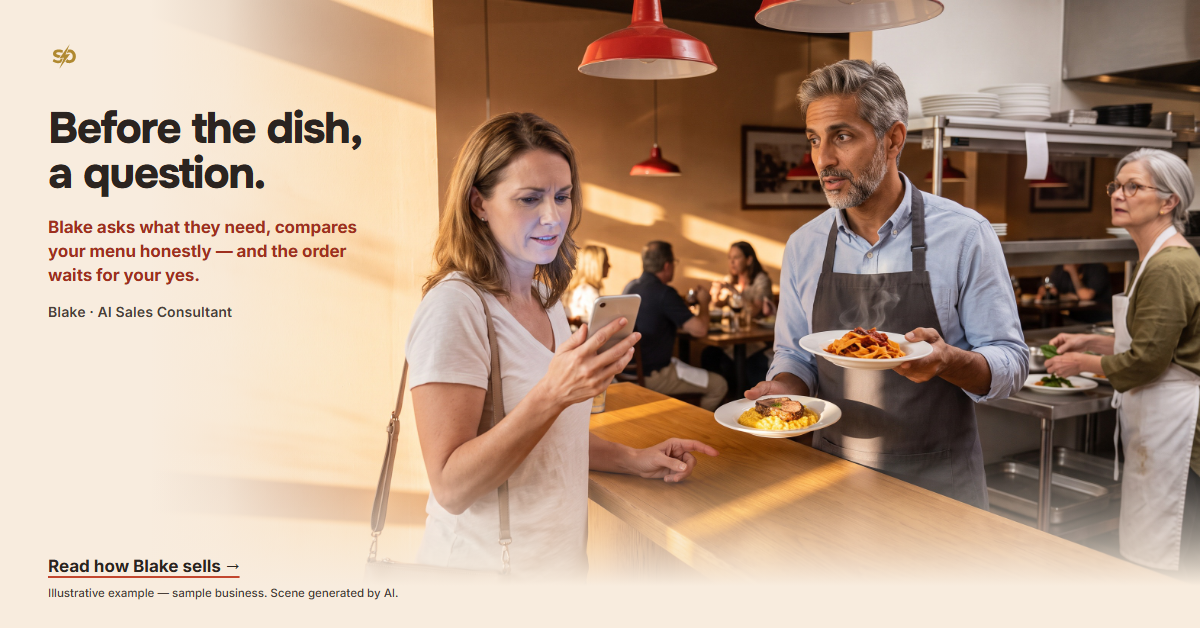
At 7:40 on a Friday evening, a message reaches Tampa Pasta House: “Which one is right for me?” Margaret Ellison can’t answer it. She is on the pass, plating, and the person who wrote is still choosing. That moment belongs to the AI employee she hires first: Blake, AI Sales Consultant.
Margaret runs a fresh-pasta trattoria in Tampa. The pasta is made every morning, and the evening is when her kitchen is at its busiest — which is also when people plan dinner. They write from the couch, from the car, from the office on the way out: which dish, what does it come to, do you have it. None of them has bought anything yet. When nobody answers, they don’t wait to think it over. They order somewhere else.
That is Blake’s whole job: the person who is still choosing.
The evening below is an illustration in our own sample business, not a customer case.
7:40 — “Which one is right for me?”
The message comes through Instagram Direct. A woman is ordering dinner to take home for her parents’ anniversary, and she is torn between two dishes: the tagliatelle al ragù and the osso buco.
Blake doesn’t open with the menu. He asks first. How many people? Is anyone avoiding anything? Eating here or at home — and how far is home? Advice without a question isn’t a consultation. It’s guessing.
She answers: four people, at home, a twenty-five-minute drive, and her father “just loves a slow-cooked sauce.”

Two dishes, one honest answer
Now Blake compares, in plain words and only from Margaret’s menu. Both dishes are braised. The osso buco is a veal shank with saffron risotto. The tagliatelle al ragù is a four-hour braise on pasta made that morning. If what her father loves is the sauce, the ragù is the one — and it is also the less expensive of the two. Blake says so.
A salesperson who always points to the expensive plate stops being an adviser by the second order.
“Do you have it?”
Meanwhile, a comment arrives under tonight’s Facebook post: do you have gluten-free options? Blake answers with exactly what Margaret wrote down: there is gluten-free pasta, and because the kitchen handles wheat, tell them about any allergy so the kitchen can take care of you. He doesn’t stretch that into a promise Margaret never made.

Then a question about something that isn’t in Margaret’s menu at all. Blake doesn’t invent it. “I don’t have that. I’ll pass the question to Margaret rather than guess.” A dish invented in a chat is a dish somebody expects to pick up.
“What does that come to?”
Back in Instagram Direct, she adds a Cacio e Pepe for her mother, and Blake passes on Margaret’s own note: Cacio e Pepe is eaten first — the cheese holds its texture for three or four minutes. With a twenty-five-minute drive ahead, she swaps it for the lasagna.
Blake shows her the exact list and the total. Every price is a line from Margaret’s catalog — he doesn’t calculate, round or estimate it — and the total is the server’s arithmetic, not a number made up in a chat.
She writes “yes.” Then she remembers dessert. The list has changed, so that “yes” no longer counts: Blake shows the new list and the new total, and waits for a clear “yes” in a separate message.
“It’s their anniversary. Can you do something?”
Blake doesn’t invent a discount, an extra or a special condition. He offers only the promotions Margaret has set up. A request for anything more goes to Margaret, written down in the customer’s own words. A concession made in a chat is a concession the owner then has to either honor or take back in front of the customer.
The last word is Margaret’s
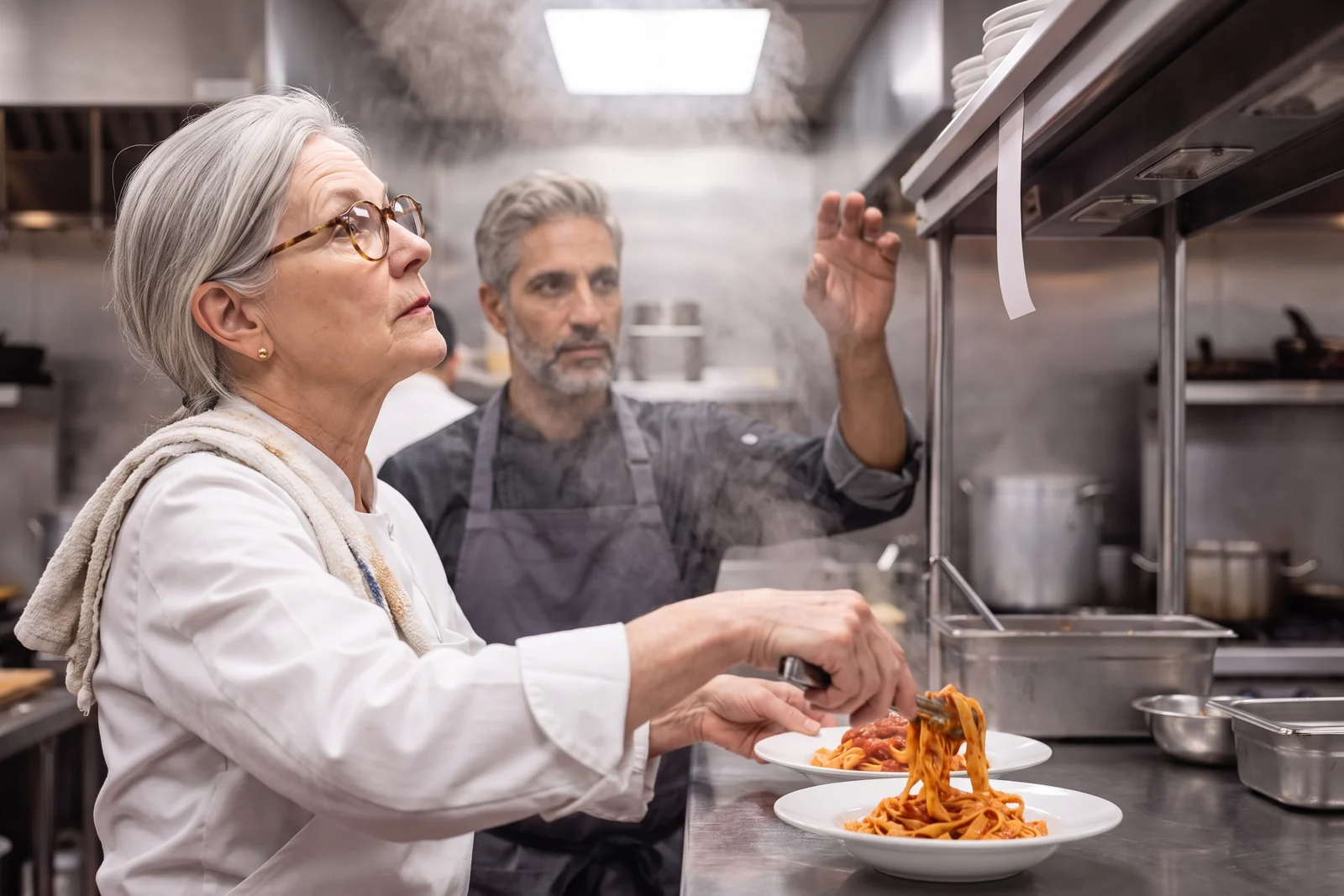
Now the order exists, and Blake still doesn’t say “order accepted.” He tells the customer the truth: the order is assembled and waiting for Margaret to confirm. On the pass, Margaret gets it with the whole conversation attached — what was asked, what was compared, why the ragù. She reads it between two plates and says yes. That step is on by default.

Money is never Blake’s. If Margaret has her own payment link, he hands it to the customer together with the total. We never take payment for her business, and we will never have a payment link of our own.
After the payment, it’s Ruby’s
Once she has paid, the questions change — where is my order, can I exchange this — and they belong to Ruby, AI Customer Support Agent. The boundary is the moment of payment, and neither stands in for the other.
What Blake never does
- names a price that isn’t in the catalog, or works one out himself;
- invents a dish, a discount or a condition;
- says “order accepted” before the owner accepts it, or promises delivery dates;
- takes payment, or decides returns and compensation;
- writes first, or comes back to someone who said no.
Hire the AI employee first
That is the order we suggest. Before you hire a person to sit in the inbox during your busiest hours, hire an AI employee for the people who are still choosing, and see what is left. What’s left for Margaret is what should be hers: the pass, the yes on every order, the money, and the regulars who want to talk to her.

Blake works where people ask before they buy: Facebook Messenger, Instagram Direct and Telegram, and the comments under your Facebook and Instagram posts. In his first reply he says he is your business’s AI assistant, and he never pretends to be a person.
Setting him up is a conversation, not a screen to learn. In the ChatGPT, Claude or Gemini app you already use, you tell him what you sell, how your items differ, what your buyers hesitate about, and what you never promise.
See the work before you hire
Tampa Pasta House and Casa Lista Home Repair are sample businesses we run ourselves, open to anyone at smashone.us/examples. Both have Blake on their staff, and their Facebook, Instagram and Telegram channels are answered by the same AI employees you can hire. Write to them the way your customers write before they buy — “which one is right for me?” — and see what comes back.
