
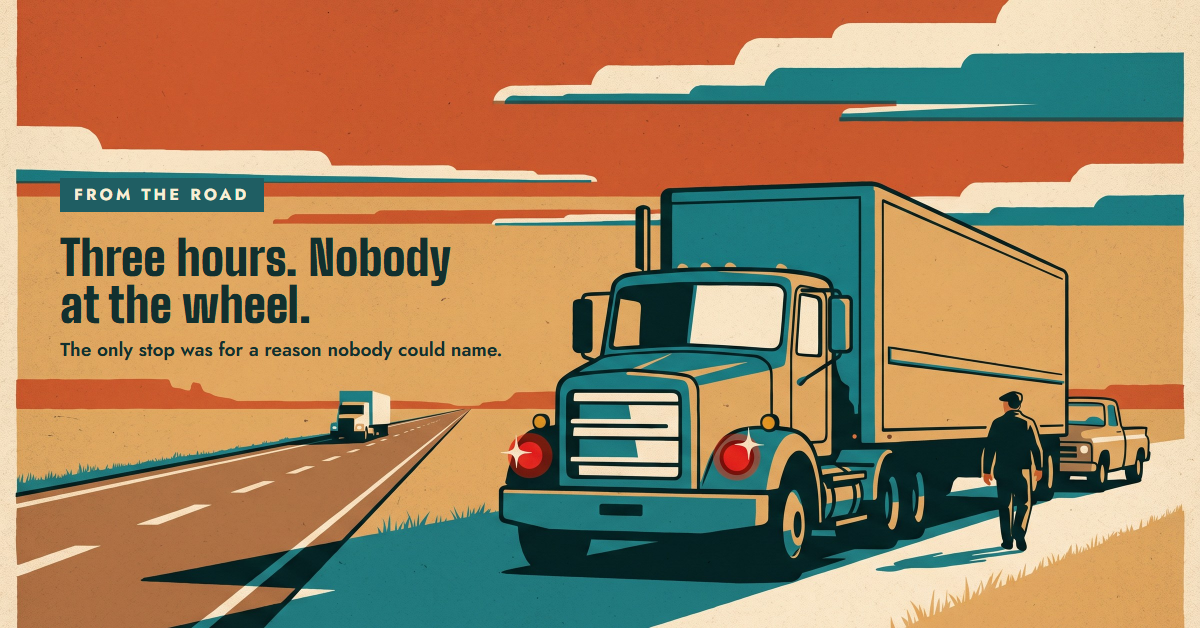
Take Interstate 45 between Houston and Dallas on a weekday and you'll pass dozens of tractor trailers. Some of them, now, have nobody behind the wheel.
In a report CNBC published this week, Phil LeBeau spent more than three hours in the cab of one. The truck belongs to Aurora, a company that runs fully driverless semis on two of the busiest freight corridors in the country: I-45 between Houston and Dallas and I-20 between Fort Worth and El Paso. "It's using lasers, radar, and cameras to look all around it and see the other cars, see the other trucks on the road, and figure out how to drive safely," Aurora's founder and CEO Chris Urmson told him on the way.
The ride was, in LeBeau's word, uneventful. Other truck drivers looked twice as they passed an empty cab. And once, for less than a minute, the truck pulled off the highway to reset its hazard lights. They had come on, the report says, "for some unknown reason."
Keep that minute in mind. We'll come back to it.
What's actually on the road
Aurora has 20 driverless trucks running today and plans to have 200 by the end of this year. An autonomous truck can roll for up to 20 hours a day; a human driver's hours are capped by federal rules that require breaks. The company has logged more than 3 million miles on public roads since 2021, most of them with a human safety operator in the driver's seat in case the technology failed. It lost more than 800 million dollars in 2025 and aims for positive free cash flow in 2028. Analysts quoted in the piece put big numbers on the idea, but those are estimates about the future, not results.
Urmson's pitch is not "we'll replace your drivers." It's closer to the opposite: "We can move goods more quickly and then we can fill the need when they can't hire amazing drivers for their teams." The truck takes the seat that is empty anyway.
The sentence that isn't about trucks
The sharpest line in the story doesn't come from Aurora or from a skeptic. It comes from Sean Wu, CEO of uShip, an online marketplace for shipping. He understands why a company would want a driverless truck. He also knows what gets lost if you only look at the cost per mile:
"The drivers do more than just move the rig. There is judgement. There is customer service. There is protection. There is just a lot more to think about than 'Hey they are moving a truck from point A to point B.'"
That's the whole debate about AI at work in four short sentences. The rig moves itself now. The judgement doesn't.
Your business has a highway too
A five-person business doesn't run semis, but it has its own long stretch of highway. It's the questions that come in at night and on Sundays, the same ones every week. Are you open. How much is the usual. Can I come at four. Do you do the thing I need. Answering them is long, repetitive and important, and it's where a tired person at ten at night makes the mistakes that cost a customer.
That stretch can run without you, the way the truck runs I-45: on your own answers, written once, said the same way every time.
And your business has hazard lights. A customer whose order doesn't match anything you sell. A regular who is unhappy but won't say why. A question that sounds routine and isn't. A promise someone wants you to make on the spot. None of these are "moving the rig." They are Wu's judgement, customer service and protection, and they're the reason people come back to you and not to the next name on the list.
The machine can run the highway. Someone has to own the hazard light.
Notice how Aurora itself got here. It put more than 3 million miles on public roads, and most of those miles still had a person sitting behind the wheel. Only then did it let the cab go empty, on two stretches of highway, twenty trucks at a time. The order matters: first you learn which minute needs a human, then you hand over the other hours.
What to take into Monday
- Make two lists. On the first, everything that is "moving the rig": the same answer to the same question, every time. On the second, everything that needs judgement.
- For every item on the first list, write the answer once, in your own words, with your real hours and your real prices. That's the highway.
- For the second list, name the three situations that must reach a person the moment they happen, and decide who that person is. That's your hazard light.
The truck on I-45 didn't know why its lights came on. It pulled over, someone reset them, and the run went on. In your business, that someone is you, or the person you trust with the second list.
What's the hazard light in your business that you'd never hand over?
