
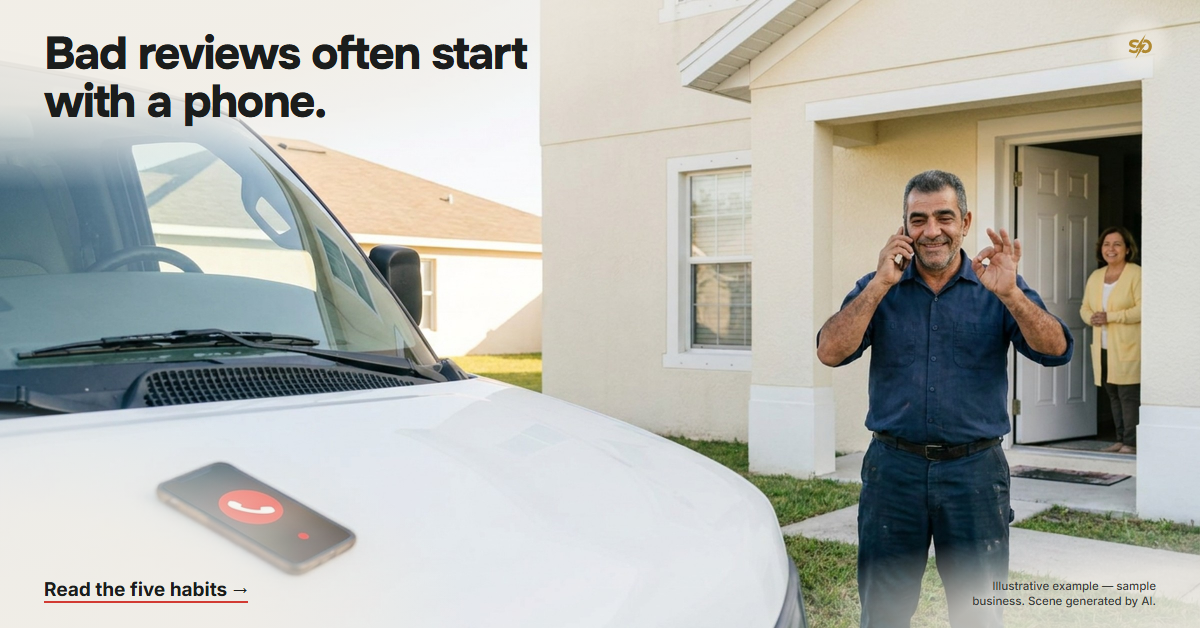
Read your one-star reviews again, slowly. Often they aren't about the work at all. They're about a phone: a call nobody returned, a technician who showed up late without a word, a price the customer heard for the first time on the invoice.
A local-search consultant put the list plainly in a post about what causes bad reviews: "Unreturned calls, being late… no-shows." And he added a warning for owners who let AI take their calls: make sure it doesn't drive your leads away.
The good news is that phone problems are the easiest kind to fix. They don't need a new truck or a better crew. They need five habits.
1. Return every call before you close for the day
The review that says "nobody ever called me back" was written by someone who waited. Make a rule: every missed call gets a call or a text back before you close for the day. If you can't call, text:
"Sorry I missed you. I'm on a job and will call you back this afternoon. What's it about?"
Some people answer the text, and then the call you return is already half done.
2. Repeat back what you heard
A "they didn't listen" review often starts with a call where the customer said one thing and the business wrote down another. Before you hang up, say it back:
"So it's the upstairs bathroom, water under the sink, and you're home after three. Is that right?"
It takes ten seconds, and it catches the mistake while it can still be fixed.
3. Say what happens next, and when
Silence after a call feels like being ignored. End every call with the next step and its time, in your words, from your schedule:
"I'll send you the estimate tonight, and we'll come Thursday morning between eight and ten."
Then keep it. A promise kept on a small thing is what makes people trust you on a big one.
4. Running late? Call before they have to
"Late and didn't even call" is exactly the kind of line that ends up in a review. Being late happens. Not calling is the part people remember. The moment you know you'll be late, call or text with a real new time:
"Running about forty minutes behind on the job before yours. New time is around 11. Does that still work?"
5. Talk about money before the work, not after
A price the customer hears for the first time on the invoice turns a good job into a bad review. Say your range on the phone, say what moves it, and say it again before you start:
"Most jobs like this land between [your low] and [your high]. If the valve is the problem, it's the lower end."
When a call goes wrong anyway
Sometimes the customer is already angry when they call. That's the review that hasn't been written yet. Don't argue. Ask one question:
"What would make this right for you?"
Then do what you can, say clearly what you can't, and follow up when you said you would. An angry call that ends with a fix often ends without a review, and sometimes with a good one.
If your phone rings while you're on a job
An AI receptionist can pick up your business line when you can't, answer from your catalog, and pass you each caller's name, number and what they need, so the call back is easy to make.
Bad reviews rarely start with bad work. They start with a call that went unanswered or a promise nobody kept. Fix the phone, and you stop many of them before they're written.
