
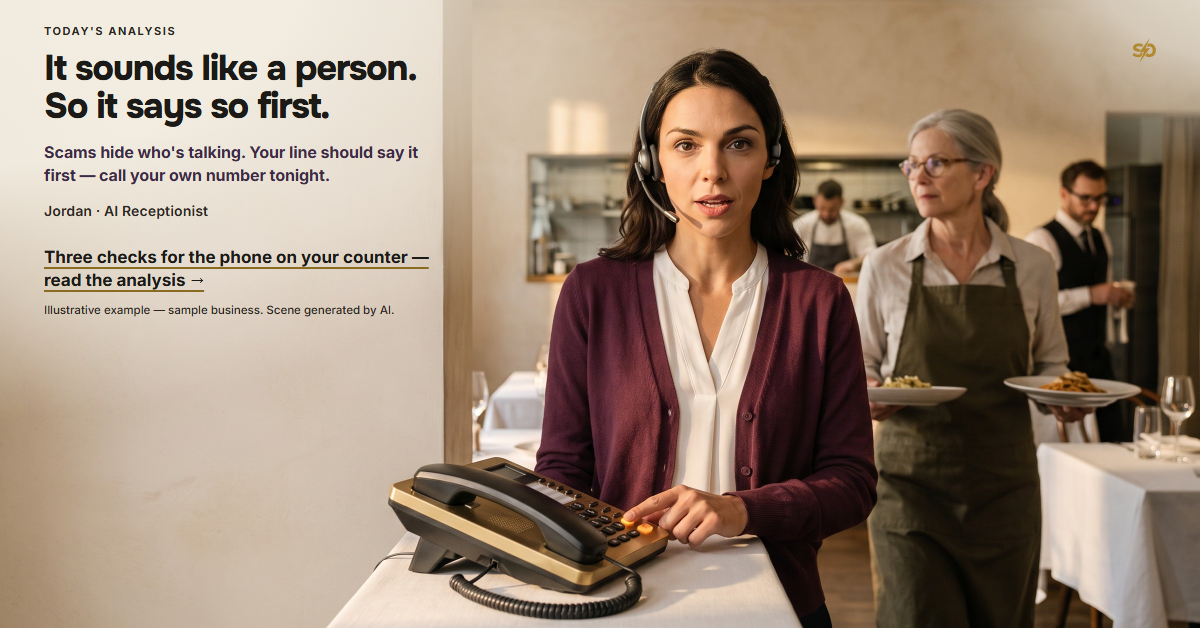
For three weeks the industry has been busy solving how a machine sounds. In the last twenty-one days our corpus collected 90 pieces on voice AI from 29 different domains, and the share of that topic grew 1.7× in a week. Read them end to end and one thing becomes obvious: the hard engineering problem of this decade — making a machine hold a spoken conversation without the pauses that give it away — has been quietly moved into the “solved enough to sell” column.
On 10.09 OpenAI put GPT-Live-1 into its API — a model that listens and speaks at the same time instead of passing audio through speech-to-text, then a language model, then text-to-speech, with telephony named explicitly as the use case. Five days later, on 15.09, Google shipped Gemini 3.8 Live: over 97 languages, tool calls made in the middle of a sentence, real-time audio. Neither company is selling you a voice any more. They are selling a phone line that thinks.
And here is the part that matters to anyone with a shop, a clinic or a van: the people who are supposed to benefit from this are not losing customers because their greeting sounded robotic. They are losing them because nobody picked up.
The number nobody in the voice-AI press puts in the headline
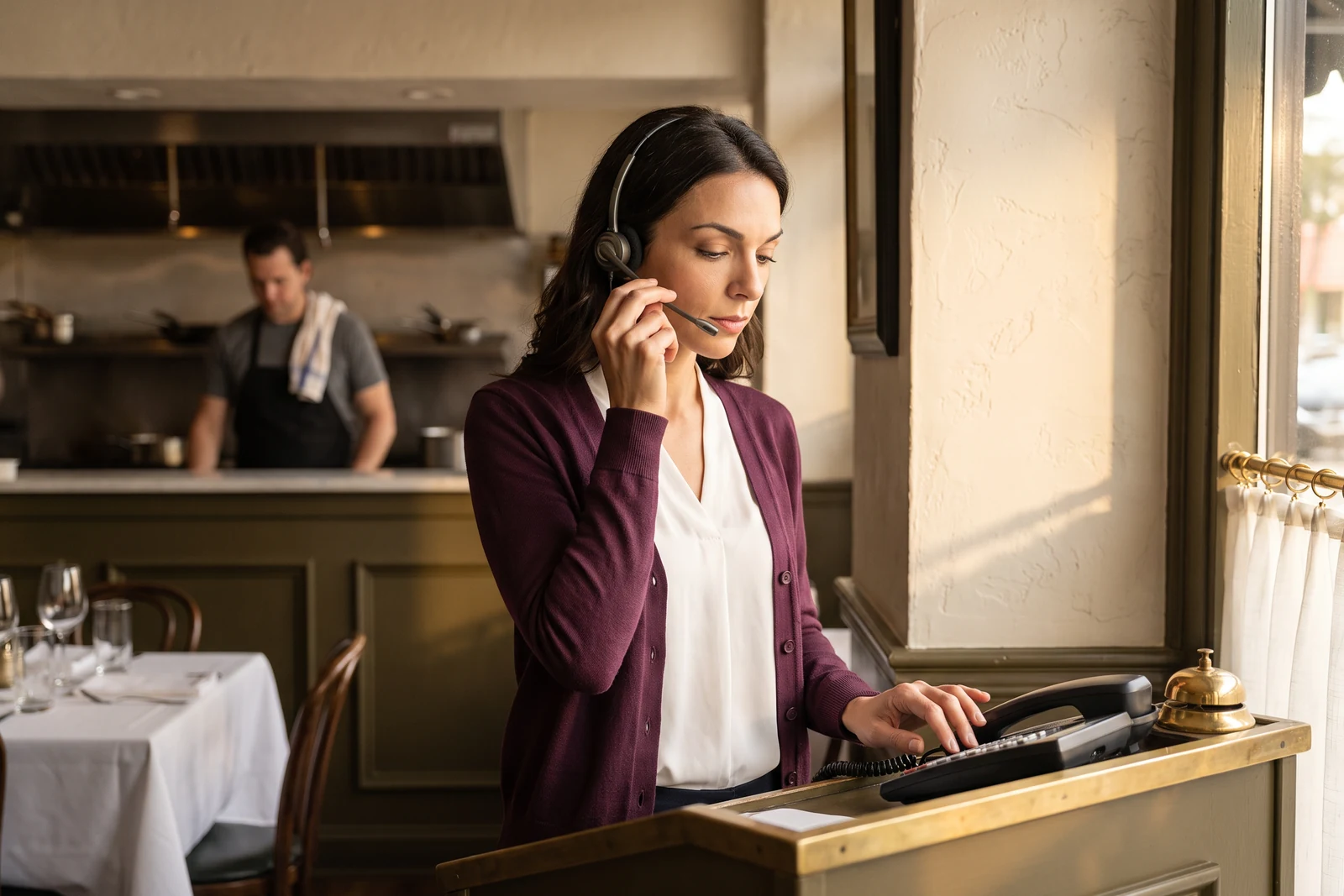
Trade press for one ordinary industry put a figure on it this month. In two pieces (14.09 and 03.09, Plumbing & Mechanical) the estimate is that about 26 % of inbound calls to service businesses are never answered, and the majority of those callers do not try again — they call the next number on the list. That is not a technology problem. It is one person with both hands inside a lock, a dryer, a dishwasher or a haircut.

The scale of the same problem in bigger retail is visible in the reporting: PYMNTS on 09.09 describes a 700-store chain fielding roughly thirty calls a day per store and moving them to a voice agent. Thirty calls a day, in a business with a counter and staff. In a one-person shop that same volume is simply lost.
Two more figures from the last ten days say where the attention actually is. Zendesk, reported 17.09 by Small Business Trends: voice is about 40 % of contact-centre volume — the channel everybody calls legacy is still the largest one. And Talkdesk, reported 14.09 by SiliconANGLE: 98 % of companies have put AI somewhere on the customer journey, but only 15 % have orchestrated it — nearly everyone has bought a piece; almost nobody has a system that answers end to end.
The money proof: an hour of conversation got three times cheaper in a week
The economics moved faster than the adoption. The Decoder, 15.09: an hour of live voice conversation costs about $1.38 on Google’s new model against $3.00 or more on the competing one. Whatever the exact figures become next month, the direction is not ambiguous — the per-minute cost of a machine that talks is falling through the floor.
The consequence for small business is already on the shelf. Inc., 17.09, reports an AI receptionist marketed to small businesses at twenty-nine dollars a month, answering around the clock in seventy-plus languages. We do not name vendors in the receptionist market, and we do not need to: the price point is the story. A year ago “a phone that always answers” was an enterprise line item. This month it is priced like a phone plan.
Volume confirms it is not a demo. Yelp, 10.09: its host product has handled more than a million calls to restaurants since October 2025, answering in the language the caller speaks.
The honest part, and where the corpus stops
This is where an analysis has to be careful, because the corpus does not support the claim that anyone is fooled.
There is no measurement in those 90 pieces showing that listeners cannot tell a machine from a person. What there is: Five9’s CEO, reported 11.09 by SiliconANGLE, saying 99 % of practitioners believe the contact centre has got better while only 66 % of users agree — a thirty-three point gap between the people who buy the technology and the people who meet it. And Inc., 16.09, citing research in the Journal of Cybersecurity: more realistic synthetic voices make certain people materially easier to defraud.
The rules are just as unfinished. Hawaii’s S.B. 3001 / Act 248 (reported 04.09) requires AI to disclose that it is not human when a user might reasonably think otherwise, and it is described as the front of a wave of state laws. NPR, 18.09: state chatbot bills are being drafted with industry at the table, there are at least 75 suits against developers, and there is no federal statute. What the corpus does not contain is any act that requires a business to announce “this is AI” on an inbound phone call, or any analysis of what the existing telephone-consumer rules mean for an AI receptionist. We are not going to invent one.
So the honest summary is narrower than the headlines: the machines got good enough that the conversation stops being the obstacle, the price fell far enough that the smallest business can afford one, and nobody has proven that customers cannot tell — or that they mind, if you say so first.
Three checks for the phone on your counter, tonight
The poster of this analysis promises three checks, and here they are. None of them needs a new tool; all three need ten minutes of listening to your own business.
1. Call your own number and listen to the first sentence. Not the greeting you wrote, the first thing a stranger actually hears. Does it say in plain words who is speaking and whose business this is? If a caller can mistake the machine for a person, the disclosure wave now moving through state legislatures is not the reason to fix it — the caller is.

2. Hire the voice, do not pick it. A technology column this month (Forbes, 16.09) put it bluntly: most owners spend about thirty seconds choosing an AI voice. Listen to yours the way a first-time customer would. Pace, warmth, formality: does it sound like your shop or like a satnav?
3. Make sure the call leaves something you can read, and a door to a person. A voice you cannot audit is a voice you take on faith. After a call, can you read what was asked and what was promised — and can the caller reach a human without starting over?

What we do with that
Here is how the same three weeks look from where we build.
An AI receptionist is a role, not a robot voice. Ours comes with a phone line inside the role: it answers by the hours and services the owner wrote down, it writes the caller’s request into the job, and it answers in the language the call arrives in — that part has become an industry norm this month, not a differentiator, and we treat it as table stakes.
What it does not do is decide. Money, refunds, discounts and anything the owner reserved for himself sit behind a stop list: the role can talk about them, and it cannot act on them. That line is the practical version of the 99-versus-66 gap — the confidence lives with the people who bought the system, so the irreversible buttons stay with a human.
And it says what it is. No law forces an inbound call to declare a machine today, and we are not waiting for one to be forced: honesty about who is speaking, a clean handover to a person, and a caller who always knows what happens next cost nothing and survive the next state statute.
You hire the AI employee first and look for a person only for what it cannot do. Setup is a conversation in the ChatGPT, Claude or Gemini app the owner already uses — no workspace, no console, no specialist. And before anything is bought, two demo businesses answer in public, so the work can be watched rather than promised.
The industry solved the voice. The call that rings out at two in the afternoon, while the owner’s hands are busy, is still there waiting for somebody to pick it up.
Sources
- OpenAI — GPT-Live-1 in the API, 10.09.2026
- Google — Gemini 3.8 Live, real-time voice, 97+ languages, 15.09.2026
- The Decoder — cost per hour of live voice, 15.09.2026
- Yelp — more than a million restaurant calls handled since October 2025, 10.09.2026
- Inc. — an AI receptionist for small business at twenty-nine dollars a month, 17.09.2026
- Plumbing & Mechanical — the cost of missed calls, 14.09.2026
- Plumbing & Mechanical — the cost of missed calls, 03.09.2026
- PYMNTS — a 700-store chain and its call volume, 09.09.2026
- SiliconANGLE / Five9 — 99 % of practitioners against 66 % of users, 11.09.2026
- SiliconANGLE / Talkdesk — 98 % adopted, 15 % orchestrated, 14.09.2026
- Small Business Trends / Zendesk — voice is about 40 % of contact-centre volume, 17.09.2026
- Inc. — realistic synthetic voices and fraud risk, Journal of Cybersecurity, 16.09.2026
- Forbes — Hawaii S.B. 3001 / Act 248 and the wave of state disclosure laws, 04.09.2026; Forbes — thirty seconds spent choosing an AI voice, 16.09.2026; NPR — state chatbot bills, 75+ suits, no federal statute, 18.09.2026
