
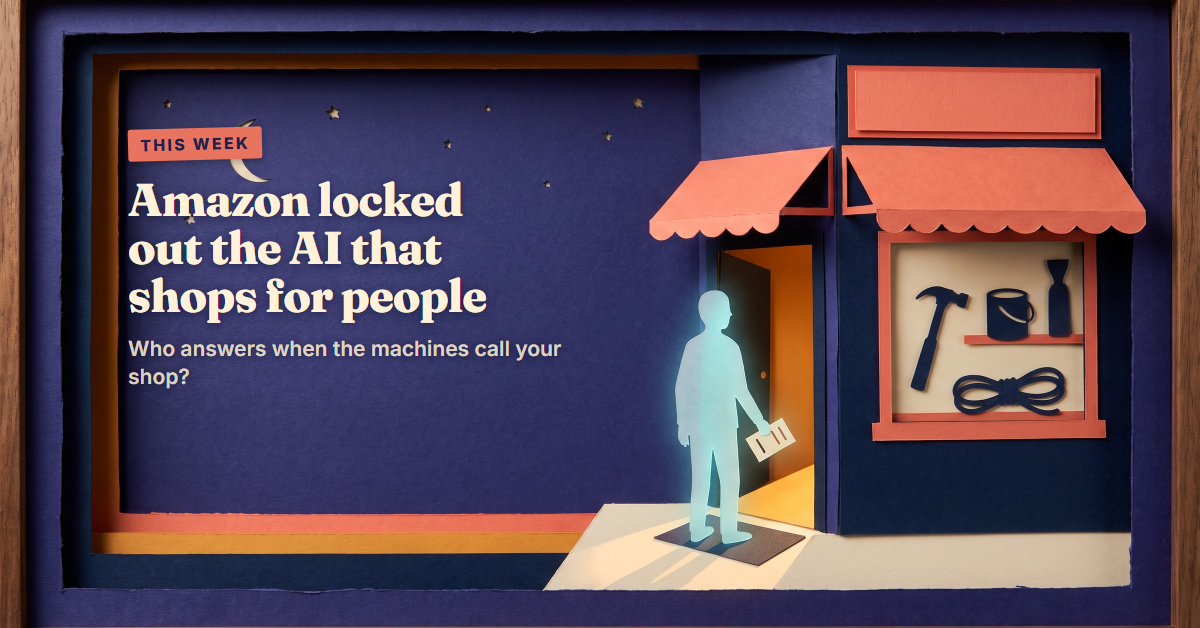
On Sunday night, September 21, Amazon blocked an AI agent from its store. Not a bot scraping prices. A consumer assistant called Muse that Meta launched in the United States earlier this month, and that, by Meta's count, 730,000 people installed in its first five days. By Friday it was the most downloaded free app in the App Store. Meta's stock rose eleven percent on Monday.
Muse works the way every owner has imagined an assistant working. You say what you need, it visits the stores, compares, and pays. Martin Peers of The Information tried it first on small retailers, buying a pen and a notebook, and called the experience "surprisingly smooth", though he added it was "still a lot faster and easier to go directly to Amazon."
Then Amazon shut the door.
Not against AI. Against an AI that would not introduce itself.
Amazon runs its own buying agent, so this is not a company afraid of the technology. Its stated reason is narrower and more interesting. Third-party apps that buy on behalf of customers, an Amazon spokesperson said, "should operate openly and respect service provider decisions about whether or not to participate." Muse did not identify itself as an agent in its requests, and it could see account pages and purchase history, which Amazon described as "an undisclosed third party moving through customer accounts."
Amazon has a lot riding on people browsing its pages themselves: its advertising business brought in more than $68 billion last year. It has also been here before. In November it sued Perplexity over a similar shopping agent, and in August a federal appeals court found that the person using the agent, not the AI company, was the one accessing Amazon's systems. On Monday Amazon added a breach-of-contract claim to that case.
Aaron Levie, the chief executive of Box, said on CNBC that the industry is "basically two weeks into this entire topic" and that agents are "going to change how we interact with most forms of commerce." Two weeks in, and the largest store on earth has already drawn its line: come in openly, or not at all.
The part that is not about giants
Read the story again and notice where the first purchases happened. Not on Amazon. In small shops. The agent knocked on their doors first, and they did not have a legal department to notice who was knocking.
That is the real news for a business with five people. Within a year, a customer's assistant will call your front desk to ask about a Tuesday opening. It will message your page to check whether you have the part in stock. It will try to book, or order, or ask for a refund. It will not say "hi, I am a robot." And Mark Zuckerberg has already said Muse may take "a very small cut" of each purchase, a cut that, in his description, may be paid by the business the customer buys from.
Most Americans are not there yet. A survey published this week found only about a quarter would let an agent shop and pay for them. But a quarter of your customers is not a rounding error, and the number only moves one way.
Amazon answered three questions for itself. Now they are yours.
Who picks up when the caller is a machine? A person who assumes it is a prank call and hangs up, or an employee who can read a plain request and answer it properly, at nine in the evening, in whatever language it arrives in?
Who owns that customer afterwards: you, or the platform whose agent did the talking, holds the history and takes the cut?
And do you get to say "come in openly, or not at all", the way Amazon did?
Amazon spent a decade learning that the last question is worth a lawsuit. A shop with five people gets to answer it this month, for free, simply by deciding who answers the door and on what terms.
What I would do tomorrow morning
- Send one message to your own business as a customer at ten at night. Time the answer. That is what an agent will experience.
- Write down, in a few lines, what a stranger's assistant is allowed to get from you without a human: your hours, your stock, a booking? A price quote? A refund?
- Decide who answers that request. If the honest answer is "nobody after six," then that is the answer the customer's agent will carry back to its owner.
The store that just blocked Muse will be fine either way. The question is whether the shop down the street has anyone at the counter when the machines start calling.
Who is talking to your customers right now: you, your people, or someone else's software?
Sources
- SiliconANGLE — “Amazon blocks Meta's Muse agent from shopping on users' behalf”
- GeekWire — “Amazon's fight with Meta: Who owns the customer relationship when an agent does the buying?”
- Retail Dive — “Amazon asks Meta to remove it from the Muse AI agent experience”
- PYMNTS — “Survey: 24% of Americans would let an agent shop and pay for them”
