
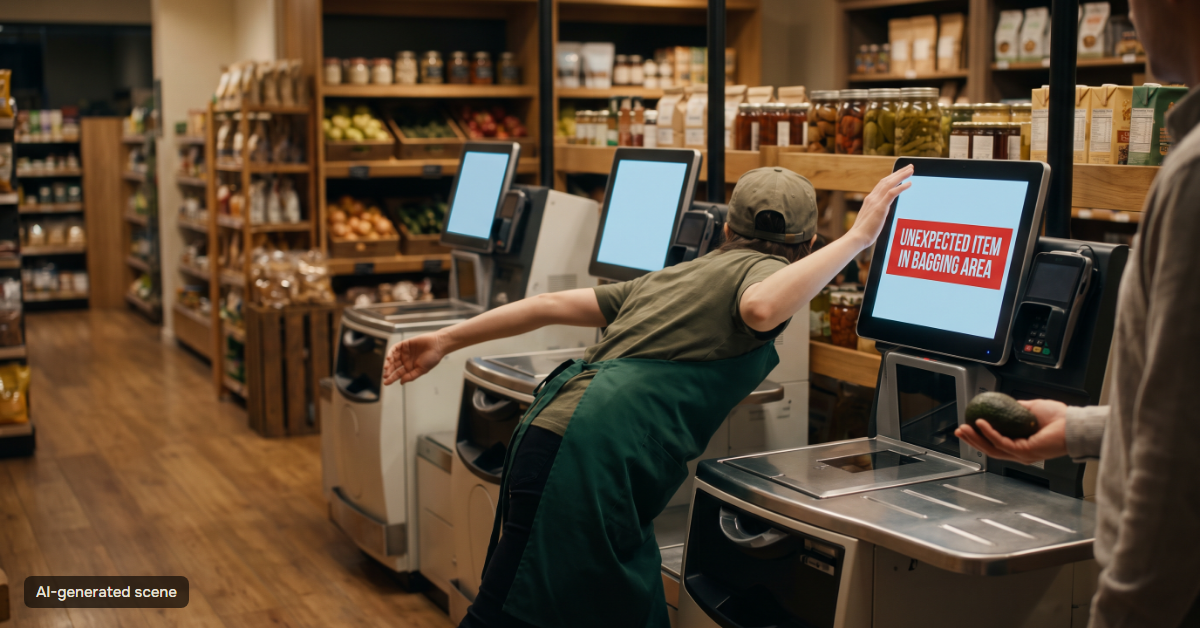
Picture a Friday evening at a corner store: four self-checkout kiosks and one employee running between them. She checks IDs for a six-pack, clears an "unexpected item in the bagging area," shows someone how to scan an avocado. Four machines, and they still need a person. Only now she isn't a cashier. She's the machines' attendant.
For five years we were told the cashierless checkout was the future. This week, the future started getting written out by law.
Three facts from the week, and what a five-person shop should take from them.
📍 San Francisco: one human cashier per three machines, by law
On October 8, Board of Supervisors President Rafael Mandelman introduced an ordinance that would require grocery and drug stores in the city to staff at least one human cashier for every three self-checkout kiosks. Not a recommendation: a proposed rule with enforcement. The city that ran the first experiments with staff-free stores is the first to try writing "a human is mandatory" into law.
Takeaway: when a piece of automation gets capped by law, it has already failed to save what it promised.
📉 Small retailers: interest in self-checkout is falling, and it's the only technology where it is
In September, Toast surveyed 340 U.S. retail operators with fewer than 16 locations. Thirty-six percent plan to invest in self-checkout, down from 43 percent a year earlier. Of every technology in the survey, it's the only one where interest dropped. Everything else (inventory, online ordering, AI for customer service) is going up.
Takeaway: small business votes with its money, and it's voting against hardware at the register.
🧾 The bill: losses went up, and no time was saved
The ECR Retail Loss report, cited by Gadget Review on October 6, found that grocery stores saw merchandise losses rise an average of 22 percent in the first year after installing self-checkout, and that stores with it lose 33 percent more than stores without. In 2024, Dollar General removed self-checkout from roughly 12,000 stores; CEO Todd Vasos said it would stay only where traffic is high and theft is low. Target capped self-checkout at ten items in nearly 2,000 stores. Christopher Andrews, a sociologist at Drew University, put it to the BBC in one line: "they're not saving money, they're losing money."
Takeaway: the register robot didn't lose because it counts badly. It lost because the register isn't the most expensive minute in the store.
What this means for a shop of five
The register is the minute when the customer has already decided to buy. Automating it saves money on the cheapest part of the visit. The expensive minute is somewhere else: the call nobody picked up because everyone was busy; the Instagram message at 10:40 p.m. that gets read in the morning, after the customer has booked with the shop next door; the email asking "are you still open?" that gets answered two days later. The big chains figured this out and put people back at the register. A small business will never have enough people for all those minutes. But a conversation, unlike a register, automates honestly: an answer while the customer is still choosing, in their language, with the request passed to you to confirm. And you can watch it work on someone else's business before you pay for it.
What to take with you
- This week, count how many calls and messages went unanswered for more than an hour. That's your self-checkout, minus the hardware.
- Don't automate what customers happily do on their own (paying). Automate what they're waiting on you for (an answer).
- Automation without a responsible person nearby turns into a "machine attendant." Name who reads the AI's answers once a day.
- Before you pay for any technology, ask to see it working on someone else's business: a live conversation or a call, not a slide.
- One channel in the first month: the one where you lose the most customers. Add the rest once the first one runs without you.
Has your register gone back to people too, or did you never try? Tell us in the comments which automation in your business never paid for itself.
