
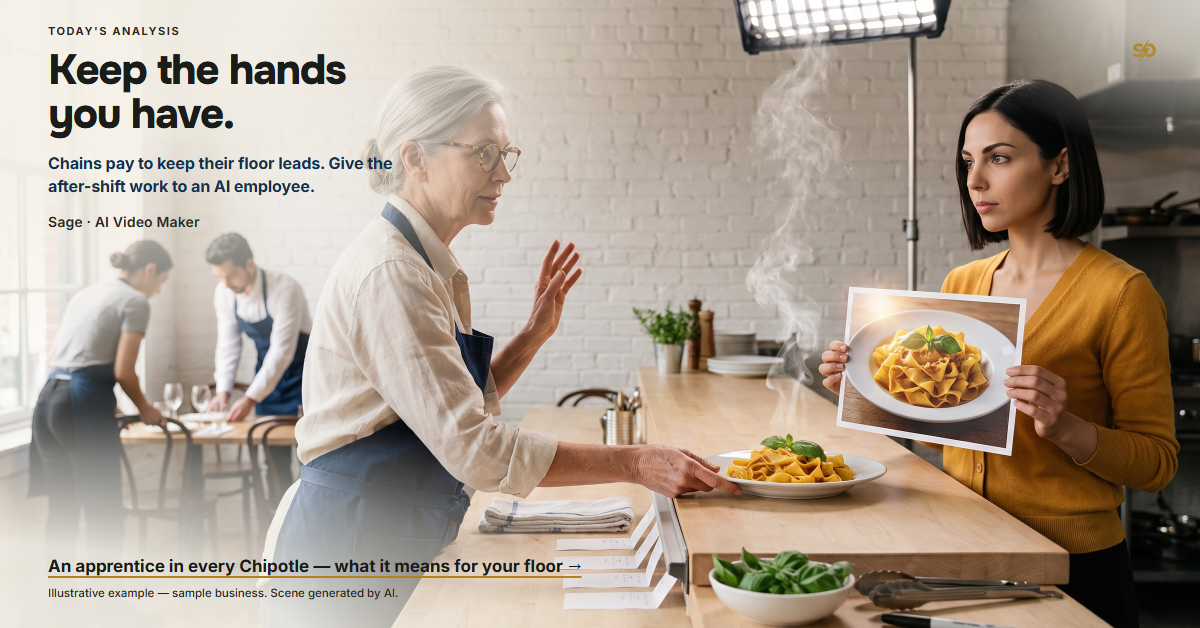
On Tuesday, Sept. 15, Chipotle said something about its restaurants that has nothing to do with burritos. By the end of 2027, it wants an apprentice — a manager in training — in each of its more than 4,200 company-owned restaurants. About three-quarters already have one.
Most of the week's restaurant news was about menus and openings. This one was about people, and there is a version of it for a restaurant with one location and thirty seats.
What the chain is paying for
QSR Magazine carried the company's own account. The apprentice is a bridge to general manager: more than 85 percent of Chipotle's restaurant managers began as crew members. But the job is not only a promotion track. Apprentices "provide additional leadership and staffing coverage during peak periods and weekends." By "taking ownership of key areas, including training and the digital makeline" — the line that prepares digital orders — they "allow General Managers to distribute responsibilities more effectively." And restaurants with apprentices, the company says, "generally achieve better operational scores."
Alicia Kelso, writing in Nation's Restaurant News on Sept. 15 as well, put the move in context: more chains, "including Cava and Starbucks, add assistant managers or similar positions to improve guest experiences and operations amid a muted traffic environment."
Read that as an owner and the pattern is plain. The chains are not adding a second pair of hands to cook faster. They are adding it so the person who runs the floor is not the person who does everything else too.
Why the person you have is worth more this fall
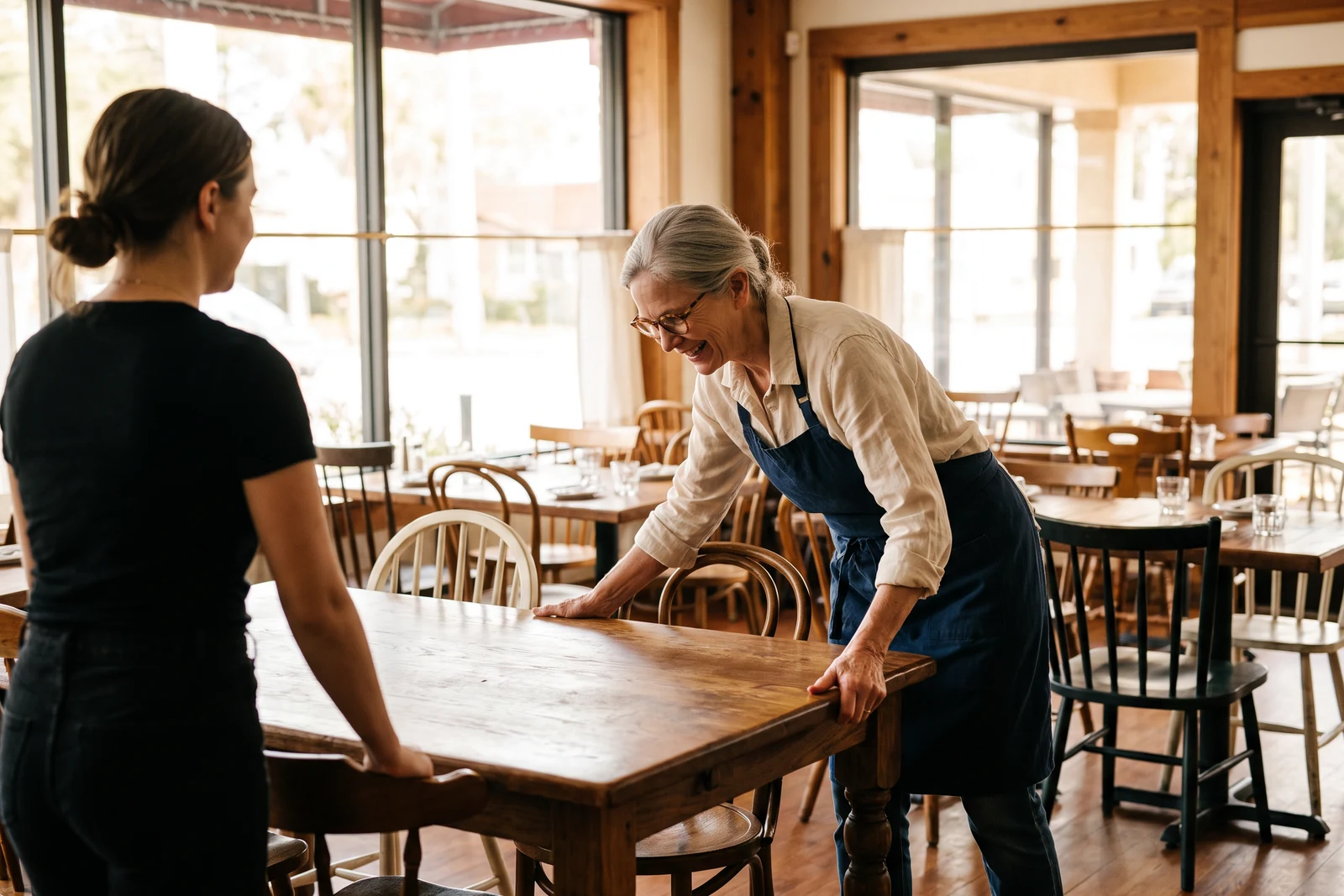
Replacing that person is not getting easier. HR Dive's Lara Ewen reported on Sept. 15 on a quarterly survey of employers that included more than 6,000 in the U.S.: only a third said their time to hire had improved compared with 2025; 42% said there was no change, and 25% said the process actually slowed down. That is while 91% of HR leaders, in a separate report cited in the same piece, say they already use AI in recruiting. The same article notes that August's job gains in the U.S. came mainly from "food services and drinking places" — your competitors for the same people are hiring.
On Sept. 11, Ewen covered a study of more than 3,700 U.S. employers: 63% reported yearly turnover of 10% or higher in 2025, and while 61% expect revenue to grow by 2027, only half expect their headcount to grow. The executive who presented the study did not name a perk as the fix. He named "the fundamentals: helping managers lead effectively, creating realistic workloads and ensuring employees understand how their work contributes to organizational goals."
Realistic workloads. In a small restaurant, that is the whole question.
The same question, from other trades
The chain was not alone for long. On Sept. 17, HR Dive's Lara Ewen reported on Monster's latest Workforce Mobility Report: of 990,922 job changes it analyzed, 63% were people who moved to another employer and kept the same job title. They were not leaving the work. "Compensation, scheduling, management, workload and advancement may be what distinguish one employer from another," the report said.
On Sept. 21, in a QSR Magazine piece about bars, Duncan Macnally put it in six words: "Employees often leave managers rather than jobs." He also named a habit most owners will recognize: "High performers often receive the busiest shifts, but consistently overloading top employees can lead to exhaustion and eventual resignation." The same day, David Ambrose, a restaurant operations leader, warned new managers that if they let things slide for their strongest performer "because they're hard to replace, you've already lost the room."
And on Sept. 22, ACHR News asked young HVAC workers what keeps them in a job. Brian Kelly of the United Association drew the line plainly: "Wages answer 'Can I afford to do this next year?' Benefits and pensions answer the question, 'Can I afford to do this for the next 30 years?'"
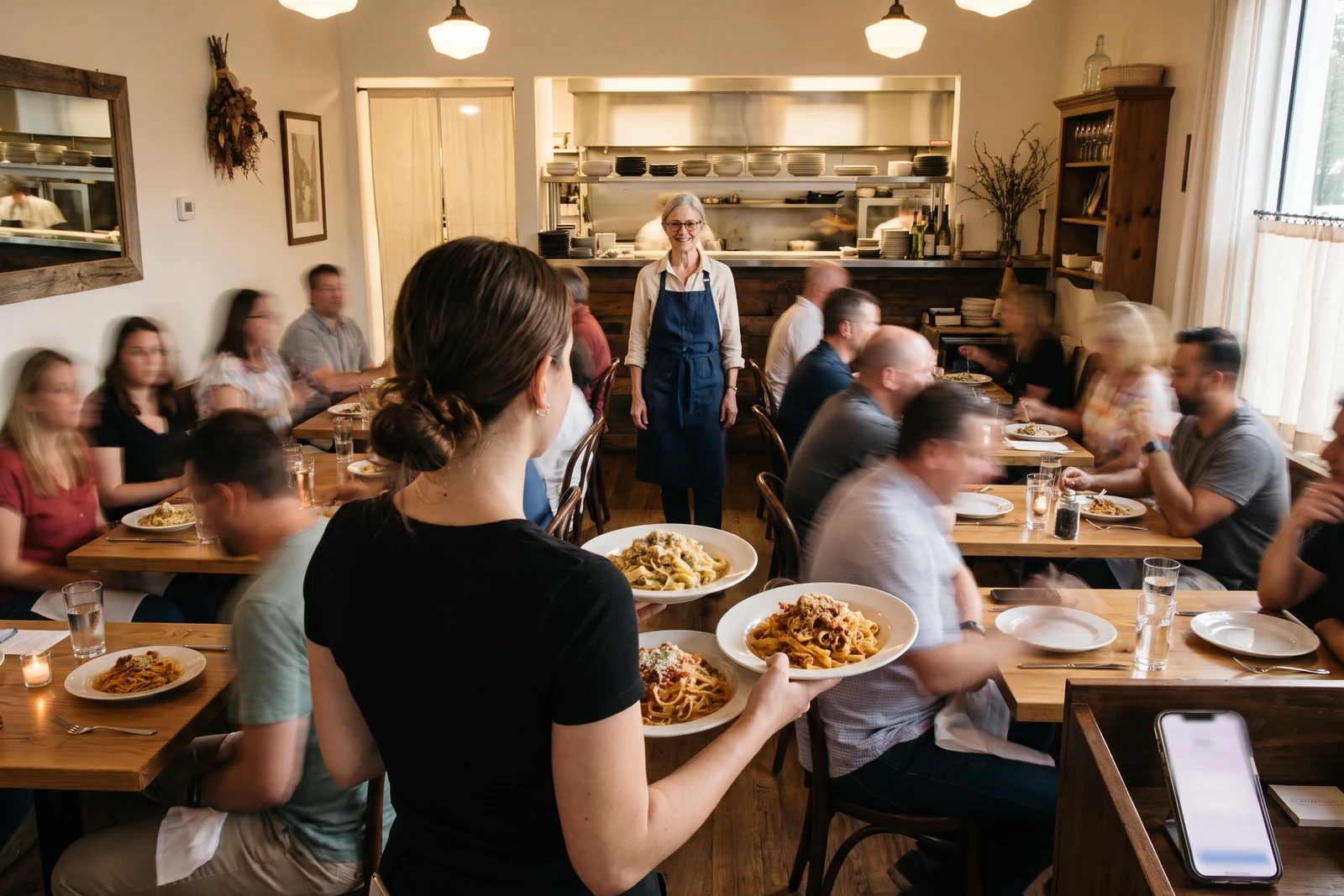
A thirty-seat restaurant cannot offer a pension like a union. It can offer the word in the middle of Monster's list: a workload that does not grow every time someone turns out to be good at their job.
Where the second pair of hands is missing
A chain can split a manager's day between two people. A trattoria cannot. At Tampa Pasta House — our sample business, a fresh-pasta restaurant in Tampa — the general manager is Margaret Ellison, the chef-owner. There is no apprentice. What Chipotle hands to a second person lands on her, or on the one person on her floor she could least afford to lose.
Julian Scadden, who leads a network of independent plumbing, HVAC and electrical companies, wrote about the trades on Sept. 15, but his line fits any small kitchen: "Technical training gets someone in the door. Leadership determines whether they stay and grow." He added that "many owners in the trades are promoted by default," and that when leadership is weak, "turnover rises, margins shrink, and career paths stall."
Promoted by default is how most small restaurants get their floor lead too: the best server, who is also good with a phone, who also updates the hours, who also takes the photo of tonight's special after the rush.
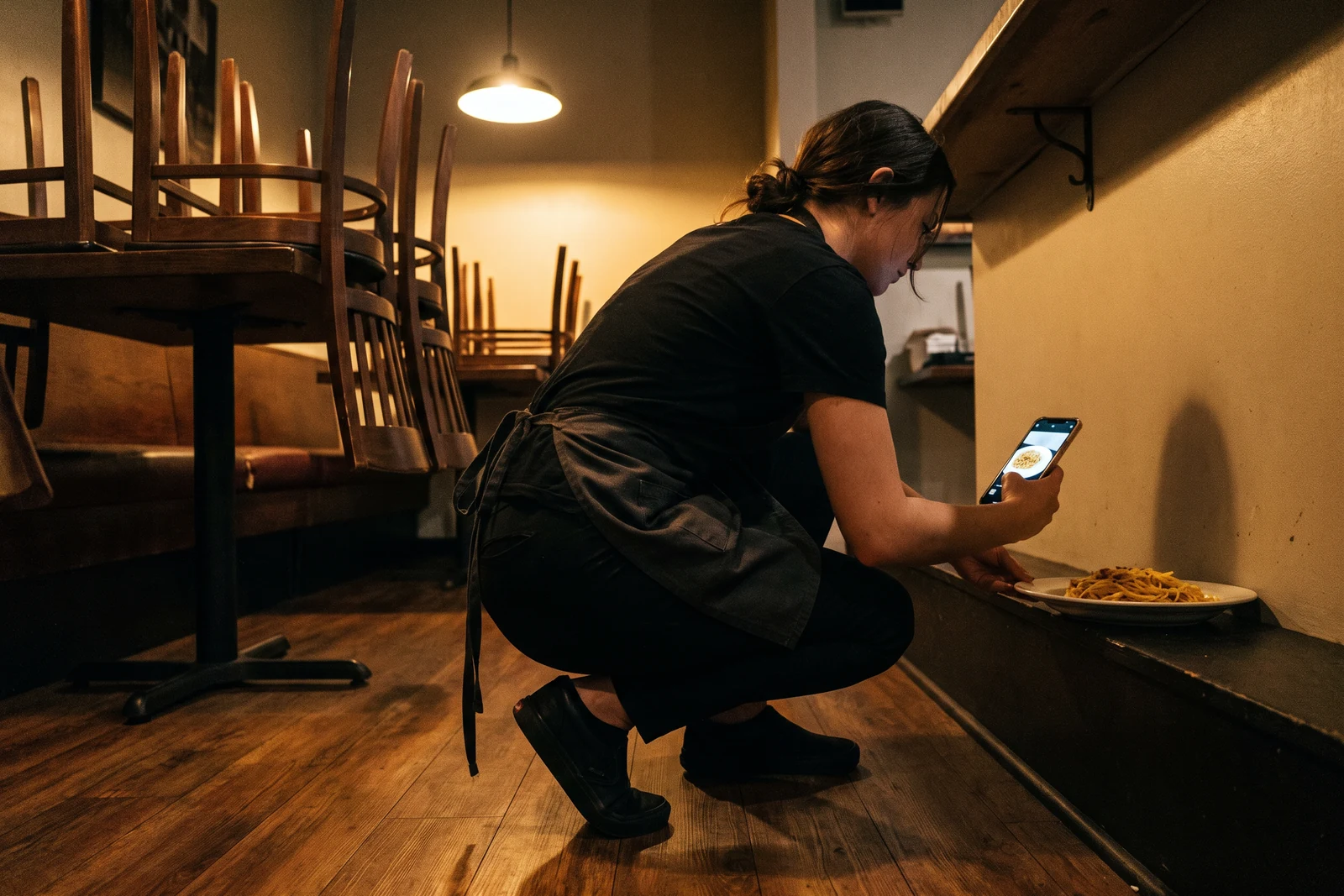
A contributed column in QSR Magazine on Sept. 16, by Aman Devgan, the president of an online-ordering company for restaurants, named exactly that kind of work. Keeping a menu, hours and reviews current should be part of daily operations, he wrote, with a repeatable process "so keeping information current doesn't depend on someone remembering after a long shift." And: "Regardless of whether an employee, an outside partner, or technology manages this process, clear ownership is essential." The survey his company ran gives the stake: 59 percent of consumers say they have decided not to order from a restaurant because they could not find basic information online.
Three checks an owner can run this week
1. Follow your best person for one shift. Not to supervise — to count. Write down each time they stop doing the job you hired them for: to answer a message, to fix the hours on a listing, to photograph a plate, to post it. Most owners are surprised by the length of that list, and by how much of it happens after the doors close.
2. Move the after-shift work out of the shift. Anything on that list that can be prepared at three in the afternoon should not be waiting for eleven at night. Anything that can be handed to someone else should not be sitting with the person who holds your dining room together.
3. Give every line a name. "Someone" is not an owner. For each line, write who does it — a named person, a partner, or something you hired for exactly that job — and what happens on the day they are off.
None of this needs a raise or a new hire. It needs one quiet afternoon and an honest list.
How we think about it
We build AI employees, so we are not neutral. We argue it plainly: before you look for an apprentice you cannot afford, hire the AI employee for the after-shift work, and keep your people for the work they came for.
Take one line that turns up on almost every restaurant's list: the photo of tonight's plate, turned into something people will stop and watch. Sage, our AI Video Maker, does that job. Every day she takes one photo from your catalog — a plated dish, the room, the result of your work — and turns it into an eight-second vertical clip, with music she generates for that clip. Your business name, the dish and its price appear on screen word for word from your catalog, and every figure is checked against the catalog before the clip is rendered. If an item has no photo, there is no clip; she does not make up the picture, the price or the promotion.
She keeps people out of the frame — no faces, no hands — so nobody on your floor has to be on camera. The finished clip and its post go into the posting slot you set, where you can look at them before they go out: Facebook, Instagram and Telegram, and your Google Business Profile by application. She makes one clip with its post a day. She does not make films or voiceovers. She is $49 a month with one channel included, $9 for each further channel, and if you let her go, no new clips are made and everything already made stays in your media library.

You set her up in plain words, in the ChatGPT, Claude or Gemini app you already use. And before you hire anyone, you can watch her work in public: at Tampa Pasta House, her job is to turn a plated dish from the catalog into a short clip, ready to post — while Margaret is on the pass.
The chains are paying to keep the person who runs the floor. The small version costs less: stop handing that person the work that starts after the shift.
Sources
- Nation's Restaurant News, Sept. 15, 2026, Alicia Kelso — "Chipotle is expanding its apprentice program"
- QSR Magazine, Sept. 15, 2026 — "Chipotle Bolsters Apprentice Program to Focus on Talent Development"
- HR Dive, Sept. 15, 2026, Lara Ewen — "AI hasn't significantly improved the speed of hiring, report finds"
- HR Dive, Sept. 11, 2026, Lara Ewen — "Poor talent retention continues to throttle company growth"
- Plumbing & Mechanical, Sept. 15, 2026, Julian Scadden — "Training Fills Jobs. Leadership Builds Careers"
- QSR Magazine, Sept. 16, 2026, Aman Devgan (contributed column) — "The Digital Friction Costing Restaurants Orders Before the First Bite"
- HR Dive, Sept. 17, 2026, Lara Ewen — "Why job descriptions should focus on workplace experience"
- QSR Magazine, Sept. 21, 2026, Duncan Macnally — "How Bars Can Build Stronger Teams and Reduce Turnover"
- QSR Magazine, Sept. 21, 2026, David Ambrose — "What New Leaders in Hospitality Get Wrong"
- ACHR News, Sept. 22, 2026, Dana Slone — "State of the Union: Young HVAC Workers Look Beyond Wages"
Note on source 2: the page is the company's announcement as published by QSR; the markup names the site's editor as author, the text carries no byline. Quotations are the company's.
Note on sources 3–4: the pages refuse our office address (anti-bot) and open normally from our research server; they were checked live from there on Sept. 17. The survey and study are described as the article describes them; their commissioning companies are not named in our piece. The 91% figure in source 3 comes from a separate report cited in the same article.
Note on source 4: the page shows "Updated Sept. 15, 2026"; it is cited by its publication date.
Note on source 7: like sources 3–4, the page refuses our office address and opens from our research server (checked live there on Sept. 24). The figures are Monster's report as the article describes it.
Note on source 6: the author is the president of an online-ordering company; the consumer figures are from his company's survey, as the column states. We did not open the survey itself.
