
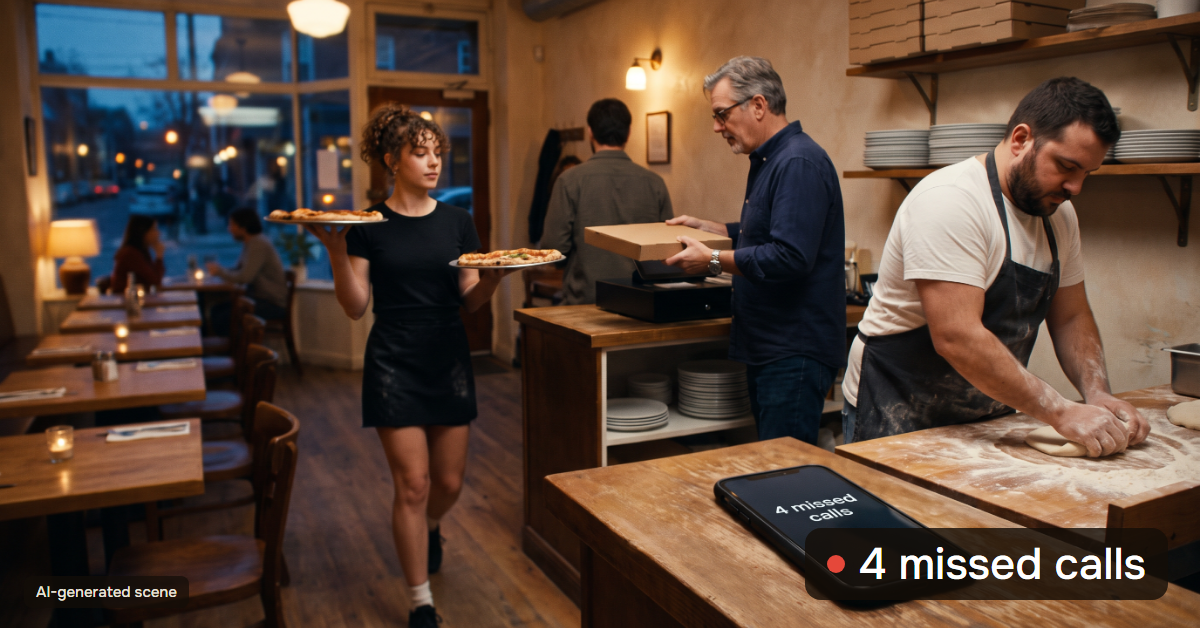
Friday evening at a six-table pizzeria. The phone rings for the fourth time in a row. The cook has dough up to his wrists, the server is carrying two trays, the owner is stuck at the register. Nobody picks up. The caller hangs up and dials the pizzeria down the street, the one that answers.
At the big chains, that same call comes through the drive-thru speaker, and for the last year and a half it has more and more often been picked up by a machine. Earlier this month, one of the largest restaurant point-of-sale platforms in the U.S. began rolling out an agent described in three words: "answers the phone."
Three facts from chains that have already been through both the win and the public failure. And what a five-person shop should take from them.
📍 Taco Bell: nearly 900 restaurants, one public stumble, and the word "learning"
By July, Taco Bell's voice AI was running in more than 890 restaurants across 38 states, Restaurant Dive reported on July 7. The road wasn't straight. In August 2025, per the same outlet, the chain had to "slow down and rethink deployment" after customer complaints and a prank order of 18,000 cups of water. On October 13, at the Fortune Most Powerful Women Summit, Yum! Brands chief legal officer Erika Burkhardt said AI "is actually increasing retention among our team members in the restaurant because it's making their jobs easier," and called the stumbles "a learning process."
Takeaway: the system survived its own failure because a human was always behind it, and the chain called the failure a lesson, not a verdict.
📊 The mystery-shopper report: the machine takes the order and loses the "thank you"
On October 7, QSR magazine and Intouch Insight released their 26th annual Drive-Thru Report: 174 mystery-shopper encounters with voice AI at Burger King, Taco Bell, Wendy's and McDonald's. AI completed the full order in 40 percent of encounters, up from 20 percent a year earlier. The share of visits where AI only said hello and handed the guest straight to an employee fell from 70 to 50 percent. But a "thank you" at the pickup window was heard 23.9 percentage points less often when AI took the order. Where the guest got a personal touch, satisfaction was 98.2 percent, against 93.2 percent without one.
Takeaway: the machine has learned to take the order. It hasn't learned the human "thank you," and that's where satisfaction lives.
🍟 McDonald's: a second try after a shut-down test, in two languages, with a readiness check
On September 23, at its Investor Day, McDonald's showed the ArchIQ platform and its drive-thru voice AI, Archy, Restaurant Dive reported: English and Spanish, accuracy above 90 percent. The first test, with IBM, ran from 2021, "struggled with order accuracy," and was shut down in 2024. This time the crew catches and corrects about 10 percent of orders before they reach the customer, and the company expects to free up at least 50 labor hours a week per restaurant. Jill McDonald, the chief restaurant experience officer, said the company checks that a restaurant is ready before anything scales.
Takeaway: after the failure they didn't drop the idea. They added a second language, kept people checking about one order in ten, and refused to scale what wasn't ready.
What this means for a shop of five
The chain has a drive-thru speaker. You have a phone. And the call nobody answered costs more than the register: the register is the minute when the customer has already decided to buy; the unanswered call is the minute when they decide to buy from the shop next door. In three weeks the big chains showed what doing this honestly looks like. The AI speaks the customer's language (McDonald's didn't add Spanish to be polite). Every order is written down where the owner can see it. Staff at the chain check part of the answers. And "let me get you a person" is a built-in button, not a defeat. That's how an AI employee works for a small business too: you hire it before you hire a second person for the phone, you set it up by talking to it in your own ChatGPT, Claude or the Gemini app, and before you pay, you watch it answer customers for someone else's restaurant.
What to take with you
- This week, count the missed calls over three evenings. That's your drive-thru speaker, and it costs more than your register.
- If an AI answers your phone, it has to speak your customers' languages, not just yours.
- Every call should end as a written request to the owner: who, what, when, phone number. "The AI picked up" with no request is the same as a missed call.
- An honest "let me get you a person" at the first "I need a human" is a built-in path, not a loss. 18,000 cups of water get ordered where that path doesn't exist.
- Have one person read the requests once a day and correct what the AI got wrong. McDonald's kept people on about one order in ten; so should you.
How many calls went unanswered in your business last week, and who counted them? Tell us in the comments.
